The Future Of Asian Art Symposium

[singlepic id=973]See notes in moleskine

Why did Jason Wing go back to China? Well Xu Bing finds it to be a massive laboratory for testing.

http://video.ft.com/v/942909968001/Xu-Bing-at-the-British-Museum

A/P/A Institute at NYU

Keynote: “Between the Diasporic and the Transnational” Dean Chan — Edith Cowan University, Perth, Australia This symposium investigates the increasingly transnational nature of Asian art and the circulation of artists and art production in multiple global markets. The focus on Asian diasporic visual culture will include panels with scholars from the International Network for Diasporic Asian Art Research and the Diasporic Asian Art Network. About the Keynote: Dean Chan is a professor in the postgraduate programmes at the School of Communications and Arts, Edith Cowan University, in Perth, Australia. He is the founding convenor of the International Network for Diasporic Asian Art Research (INDAAR), and an executive member of the Asian Australian Studies Research Network and convenor of its Visual Arts and New Media cluster. Chan is a chief investigator in an Australian Research Council (ARC) Discovery Project entitled "Being Asian in Australia and the United States" and a guest editor of a special issue of Amerasia Journal (2010) titled "Asian Australia and Asian America: Making Transnational Connections." He has most recently been appointed as Editor of the Diasporic Asia section in Asian Studies Review, a scholarly journal published by Routledge. Response and discussion with Melissa Chiu Museum Director and Vice President of Global Art Programs, Asia Society

Panel I: Organized by the International Network for Diasporic Asian Art Research "Locating Globalism: The Diasporic Contexts of Asian Art" Alice Ming Wai Jim, Concordia University at Montreal — “The Paradox of Diasporic Asian Art from a Global Perspective” Yu Yeon Kim, Independent Curator Jacqueline Lo, Australian National University — “The Limit of Professional Foreignness: Memory, Migrancy and the Asian Diasporic Artist” Chair: Dean Chan, Edith Cowan University

Panel II: Organized by the Diasporic Asian Art Network “Asian American Art and Global Flows” Midori Yoshimoto, New Jersey City University and Galleries — “What Does It Mean to be a Diasporic Japanese Woman Artist Today? The Case Study of Chiharu Shiota” Laura Kina, DePaul University — “Field work and sewing signs” Chair: Alexandra Chang, A/P/A Institute at NYU — “The Art of Cosmopolitanism — A Translocal Positionality” Discussants: Margo Machida, University of Connecticut at Storrs Tom Looser, NYU East Asian Studies

Dream:in NY

At Parsons the New School for Design, the Assistant Professor and co-director of the DREAM:IN Project Carlos Teixeira and its collaborators shared the latest development on the project, as well as invited participants to engage the movement of transforming DREAMS into tangible realities in India.


The Opportunity: designing for billions/Bruce Nussbaum a model for growth that is incredibly inclusive [singlepic id=930] Pt. 1 helps reframe issues from problem solving to aspiration enabling

Pt .2 creates a database of dreams pooling those dreams pool of aspirations is a different start up model a different devel model than i've ever seen before [it aggregates dreams from all socio-economic levels - that can "scale" beyond a global scale]"

multi-vectorial - influence in lots of different areas they tend to be systemic on multiple levels

Dream:in is concise but has it's impact on different aspects of society. I hope we see it applied all around the world.

The Vision: what Indians are dreaming about/Sonia Manchanda (Video)

The Vision: what Indians are dreaming about/Sonia Manchanda everyone has the right to dream. the ability to look beyond tomorrow - that's what makes us human

a new stream of collective consciousness and the best reality check ever. dreams to measure for prosperity and progress

The Project: a crossroad for large scale innovation / Carlos Teixeira [singlepic id=898] One of the biggest challenges of that model is going to be scale

people say the brazil you grew up in is not the brazil that exists now.

the middle east is hungry for change.

while GNI is high and growth rate is high, they operate and live on very

when Mubarak came to power there wer apprx 40M people, and when he was overthrown, it was we have to calculate by the bilions

put everything into terms of scale and speed.

we never had in human kind a growth of this speed and this scale everything we know is going to be too small and too late we have to rethink how we innovate it's not enough for us to innovate

we need to bring global expertise in large scale to local needs, local expectations and local aspirations

talent + capacity to fulfill the local aspirations in the end we need to travel, it's not enough for us to just do communication.

there usually aren't people investing in what he calls "phase zero:" ex: not the next iteration of a project but how do we start from a brand new slate designing before people identify a need blueprints for how the future is going to look like,

for implementation: using crow sourcing and crowd funding

how do we work with investors? how do designers work with venture capitalists on phase zero for social good. do that large scale and very fast.

DBR Dream Believe Realise Network (of organizations) Design - Spread Support - idiom Collaborators - vivarta, nodes Design Knowledge Network, Parsons School of Design Strategies, Partners - Kishore Biyani, Manipal University, Dr. Ranjan Pai

The Journey: 101 dreamcatchers, 25,000 km, 3,000 dreams/ Video + Rahul JVK and Natalie Wang [singlepic id=923] local translation - partnering with students from local areas that can speak the local languages

Security - all towns were had their army informed that the students were coming. [singlepic id=900] Natalie showed tools to foster data gathering and dream catching as well as other artefacts for design research.


The Conclave: 51 Investment Opportunities, Video + Bruce Nussbaum, Ken Stevens, Heico Wesselus, Olivia Jezler, and Margarita [singlepic id=927] 18 dreams, 38 dreamleaders, 12 dreamcatalysts, 40 dreamscholars, 21dreamrealisers, 38 dreamventures.

Heico: [singlepic id=901] [innovation comes from previous experience]

[singlepic id=904] example dream: Humara Worlds large population and high density a how can you develop a mechanism to connect the village with the city?

no just personas, but actual people.

Ken Stevens: use of digital devices as an escape - a common event in many cultures when in a project with time and resource demands - you don't have time to ask or force them to change their behavior. we just by passed him. [singlepic id=927] people naturally gravitated towards those with better listening skills, better at idea combination and better synthesizers

there was no hierarchy as there shouldn't be in a flash team.

we have a lot of latitude for behavior


The Mission: dream realization, Carlos Teixeira [singlepic id=924] Some people could dream but did not have the infrastructure or conditions to realize those dreams.

Bruce was going to present on the ideas, but we have millions of dollars of intellectual property here. ex: WEB- women empowerment bank ex: Citizen Training Institute ex: Assurance company - creating a network where one of the focuses for example could be mentoring. ex: Edu Cafe - an internet cafe cum education cafe. dream catalyst - Bruce Nussbaum leverages existing infrasturuce such as internet cafes and creates a sustainable ecosystem that benefits all its stakeholders - business owners, corporation, customers and end-users. ex: Ticket to Parliament

Some of the main themes were - waste, food, sports, nation building, education


Open Innovation @ Parsons: the NY hub, Carlos Teixeira and Rahul JVK Call for action:

Now we are inviting you to: meet the experts and thought-leaders world wide learn to identify and adapt local insight for opportunities start-up new ventures raise funds co-design organizations and become a leader.

Dream:In is ready to mentor 3 teams of 5 volunteers (young global entrepreneurs) to start up one of the following ventures in India...

Seven potential ventures:

1. WEB: Women Empowerment Bank 2. APNA SAPNA (Assurance) 3. Ticket to Parliament 4. India Sports Portal 5. Pop-up Fun School 6. Sports Army 7. Health Phone

Perfect for anyone who wants to start crafting their skills as a leader.

Dream:in will provide... global expertise to local challenges mutli-disciplinary mentorship on demand online training access to experts, leaders scholars, and investor visibility through our communication and events and the opportunity to become a leader.

Send an email with the subject "start-ups" to dreamin.ny@dreamin.in They will contact you back with guidelines to participate in the selection process.

Design is never in phase zero so we want to relocate finance to the right point.

Start ups of start ups Funding - crowd funding, larger investors, an endowment etc.


Collecting New York's aspirations as a canvas for creative thinking.

Follow on twitter: http://twitter.com/DREAMIN_NY Find out more about Dreamin NY http://dreaminnewyork.wordpress.com/ Find out more about Dream:In central project: http://www.dreamin.in


[nggallery id=72]

Iteration of VC "Industry"

As VC is stressed in the recession and struggling as a model in the United States we're seeing new players move into that arena.Since large ad agencies owned by holding groups also have to adjust their model, some of them are developing VC capability. (These are the firms that were not the pioneers in "digital" (AKQA), or "interactive" (Barbarian) even if they now have an arm that offers that).

There were some agencies that developed brands in-house, incubated and launched them (Berlin Cameron, Fuse). But that takes human resources away from their consulting and forces them to become product managers as well as an array of other B2C responsibilities.

This seems like a good next step, excited to see how it turns out.

Having VC capabilities allows them to transfer their consulting abilities to advisory abilities.

In addition to injecting funding, they can also provide "the creative capital that can't be found elsewhere." That is more than the support a traditional VC will provide.

"Most early startups can't afford to go to agencies, they're too expensive. And many startups don't have leadership with business acumen that agency execs do."

Another view from founder and CEO of Loopt, Sam Altman, is to get investors that have "a ton of experience building companies and understands what it takes to scale."

The difference between a small business and a start-up is scale, start-ups can scale exponentially.

So finding those that can help you move quickly on the right track to scale.

We are seeing an iteration, or iterations, of organizations that fund ventures. Like Bjarke Ingels equated the design process to mapped evolutionary trees, some of these organizations that fund ventures will succeed and be iterated further. Some will go extinct.

Iterations upon this can feature investors also being developers that have understanding of marketing but core competencies in helping "build" the "products" the venture sells.  Adage outlines how "VC" can move from just investing and advising their venture to placing the venture in the complex markets.  That can be furthered by having different types of consultancies also getting into VC.

http://adage.com/article/agency-news/venture-capital-offers-latest-tactic-agencies/226807/

Learning By Doing - Tucker Viemeister - Design At The Edge

Learning By Doing - Tucker Viemeister, FIDSA, Lab Chief, Rockwell Group Recap A good presentation on an industrial's stating his work history and view of environment design and interaction design and where design may be headed. He relates play to learning and design.

Opinion & Questions: Design should be validated via feedback loops as should education. How does Tucker validate his design decisions, are there specific times when rockwell will revisit a client to gain insight on an intervention's performance?

How can we break flow down? Play and design are processes, not bulk "states" If flow is not a bulk state, how do we access it? What does that process consist of ? Five years ago at the Design+Management Lecture Series Tucker faced the question, "Is it ethical to do work for Coca-cola when the drink is so unhealthy."

His answer back then was slightly better.

It was along the lines of, "I think it's ok for people to have as a treat everyone in a while, but not something they have all the time." This time he also noted that it is up to the individual's self restraint. With in five years I thought he would have a better answer. Maybe a long the lines of: 1. I made it taste 43% better without adjusting the ingredients. We made it sweeter without adding any sugar. 2. In many countries water isn't sanitary to drink. So coca-cola is a safe and clean alternative. In these countries the formula for the syrup is different and can contain less sugar. 3. It's a treat that can serve as an introduction to something healthier. Coca-cola can introduce the consumers the product line of healthier drinks like Minute Maid, a brand Coca-cola owned long before the recent trend of CPG companies like Nestle and Lays trying to reposition themselves as a "health brand."

Question & Answer from the audience.

See below for work history and chunked notes. Thesis: play=learning=design

Topics: Progress molecules - when complexity really started iterated into plants and animals

  • "if we don't have progress we're going to go backwards" "Entropy"
  • "That's the basic idea of life"
  • evolution process - "learning by doing" Bjarke Ingles - design process' iterations evolutionary tree

    Me(about Tucker & his influences)

  • His father graduated from Pratt and worked at Lippincott
  • His father and friend designed everything from logos, to houses, one of the first cases of using Helvetica in a logo
  • "Be ashamed to die until you have won some victory for humanity." -Horace Mann, address at Antioch College, 1859

    "If you can't make it more beautiful, what's the point." Rowena Reed Kostellow of Pratt

    started Smart Design with David Koll

  • most famous product - OXO Good Grips
  • (addressing the users on the polarities can created something "universal")
  • opened frog design New York Harmut Esslinger

  • "Forms Follows Emotion"
  • combined new media (see photo)
  • went to work with Razorfish

  • "Everything that can be digital will be"
  • worked at Spring Time (with Dutch industrial designers)

    started Studio Red -multidisciplinary design studio

  • example work - club med:
  • [evolution of clientele from singles to parents with young kids, to parents with teens]
  • ex: hangout space.
  • example: coke cruiser.
  • 43% of those that got the cola from the mobile cart thought it tasted better.
  • working more with Rockwell - Set for the Academy Awards

    -jetblue JFK marketplace

    -Sheraton - Lobby Project (2007)

  • "how to liven their lobbies to make it a better experience"
  • activities, food cart, green wall, interactive wallpaper, game tables with glowing lights,
  • -Venice Biennale - Hall of Fragments

  • interactive mesh mockup showing pieces of the film
  • "create this open ended experience."
  • -The Cosmopolitan - casino in Las Vegas

  • used million crystal beads
  • Imagination Playground

  • playgrounds in a box
  • [singlepic id=886] Play The pedagogy of play "I'm talking about learning, not education."

    history of kindergarten

  • Friedrich Fröbel
  • Horace Mann
  • Patty Smith Hill
  • concept of "gifts" or tasks for children to complete, activities, etc.

  • John Dewey
  • "child centered, diverse, people learn by doing"
  • Montessori
  • "Montessori schools - learn what kids like to to, help them do that."
  • Johan Huizinga
  • Free-form, unprogrammed play

    "Play is like a system - it has rules" "Play is valuable" "Playing is one of the ultimate things we can do" "That kind of jamming is what's known as flow." [singlepic id=890] "Flow is like play and design, that is towards progress" [singlepic id=891] Relation of Science to Design We're not just a bunch of scientists, we're artistic too, w'er trying to make stuff that's beautiful and feedback with customers and users democratic, political, iterative [singlepic id=893] "By doing that we get products, places and services and create this solar system of things. It's a network of facets that are complex and contradictory."

    Business "Business is really easy, it's just like making candy, and candy is like money" Business men have really dropped the ball.

  • "We've moved from the industrial age to the post industrial age, where info is more valuable than objects."
  • "We're not mass producing stuff anymore.
  • "robots are doing all the work and having all the fun"
  • "80% of the people working are doing service jobs or creating hot air."
  • Design For Business

  • ex: origional Apple iMacs - when the colors were named flavors
  • "So the future is in teaching/learning or security."
  • Design is the fuel for the business not design for business, but biz for design, because we make real stuff."
  • [but all his examples are where the design is present - in security, design is often not visible,]

    “There are professions more harmful than industrial design, but only a few of them.” -Victor Papanek

    Kindness what's "better " anyways? kindness and happiness are good ways to measure design

    user centered

    Mentioned erector sets, tinker toys, lincoln logs, unit blocks - longy, bricky, buttery, squary,

    [nggallery id=71]

    More about Rockwell Group on their website.


    This lecture is part of Bruce Nussbaum's Design At the Edge lecture series.

    Acumen Fund - Moral Leadership for a more Inclusive Future - Design At The Edge

    Screen-shot-2011-04-12-at-1.20.11-PM.png

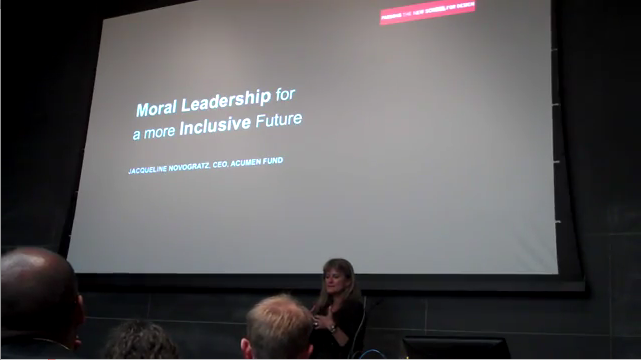
    Moral Leadership for a more Inclusive FutureJacqueline Novogratz, CEO, Acumen Fund

    Opening Points I. Dignity is more important to the human spirit than wealth. Think more broadly about what poverty means.

    II. Charity and aid alone will not solve the problem of poverty.

    Charities "create dependency rather than dignity."

    Jacqueline Novogratz describes Acumen Fund as a "non-profit Venture Capital fund for the poor investing in companies, leaders and ideas."

    "Investing philanthropic funds." "Think much more seriously about our systems" "At Acumen it always starts with the people." "Can take five to fifteen years for the [financial] returns to come back"

    Acumen Portfolio Examples Ex 1: Husk Power Systems - Bihar in India http://www.huskpowersystems.com/ Many of the people have been profiled as "economically impossible to reach economical means" "gasifiy the rice husks" "via minigrids that can reach 10,000 people" made with bamboo sticks and "strings" as electric lines. currently reaching about 170,000 people with Husk Power [singlepic id=874]

    Ex 2: http://www.1298.in/ In India 90% of people in ambulances are dead. Taxis are used more often for ambulances Ambulances are not regulated, It took private initiative an private capital to build it.

    brand image differentiation - yellow color, unique phone number 1298 avoid corruption - not taking bribes. ethos - service for all - patients are taken to free clinic marking - subsidizing their costs, they display advertisements on the side invested - started with 9 ambulances in 2007, a year before the Mumbai terrorist attacks, and will soon reach 1,500 ambulances [singlepic id=875]

    "create systemic change" "We're already seeing it replicated in other countries"

    Ex 3: d.light http://www.dlightdesign.com/ consumer product instead of Kerosene lamps [singlepic id=876] "in the 80's and 90's it was top down." "you'd come in and" say "here's this solar plant" [hard to diffuse]

    Ex 4: Housing - Jawad Aslam blank land outside of Lahore Pakistan Javat - a year to register the land because of the corruption [diffusion problem] - no one trusted that there would be jobs around [meta-system problem] -it's connected to status, wealth, beauty [the opposite of Tata car]

    Ex: 5 Western Seeds http://www.westernseeds.com/ sells hybrid seeds in Africa [singlepic id=877]

    Acumen in Kenya -fortified porridge -public toilets - previous attempts at innovation here have not diffused

    Future "The Road of Fear" -"evident in terrorism, business" The other road...

    "Road of Justice of Love" -"the only road that takes us where we need to go." -takes us into a "single tribe"

    This is a time of "great instability and great opportunity"

    "Using the power of the markets and smart design"

    Investing Model: "Scale - we don't want to invest in anything that will reach 1M people" "typical capital commitments range from $300,000 to $2,500,000 in equity or debt with a payback or exit in roughly eight to fifteen years." (AcumenFund.org)

    Even though their investment period is about eight to fifteen years, Acumen Fund considers their investing to be venture capital because they invest in early stage companies. Their exit may consist of: the management of the company they invested in buying back shares, or selling to a strategic investor, or continuing to earn dividends.

    They also engage in what they call "Lab Investments," which "are smaller-scale, high-risk experimental investments, where funding can be disbursed rapidly and lessons can be learned in the short-term."

    Primary Investment Criteria: Potential for Significant Social ImpactCompanies need to make a product or deliver a service that addresses a critical need at the BoP in the areas of our strategic and geographic focus. Delivery of the products or services should generate social outputs that compares favorably with products or services either currently available on the market or through charitable distribution channels. Potential for Financial SustainabilityA clear business model that shows potential for financial sustainability within a five to seven year period, including the ability to cover operating expenses with operating revenues. This period corresponds to the tenor of most commercial loans, and positions entrepreneurs to access commercial finance in the future. Potential to Achieve ScaleAn objective of reaching approximately one million end users within a five year period with the benefits of the product or service. If the entrepreneur's business model does not aim to reach one million consumers, does it have:

    * The potential to grow by an order of magnitude (i.e., 10x) within five years? * Potential for material impact on the social problem it is trying to solve? * A position as one of the leading service providers in the market in which it operates? * A strong and experienced management team with the skills and will to grow a sustainable enterprise at the BoP? * The presence of a strong management team that has the requisite skills to execute the business plan and a clear and compelling vision? * A management team with the will to work with the market to achieve the goal of serving the BoP? * A management team with positive ethics? (via AcumenFund.org)

    Insurance Models -does not work if when everyone gets sick.

    Working at the macro-mezzo and micro level -to set up a much more robust system.

    Speaking about the current insurance model in the US. "in some ways, we'd have to burn down the health insurance system"

    Resources and people mentioned: Innocent Anthropologist Buckminster Fuller


    This lecture is part of Bruce Nussbaum's Design At the Edge lecture series.

    Creative Intelligence

    Bruce Nussbaum's lecture on Design at The Edge is one of my favorite.I'm not enrolled in it, but still feel obligated to sit in every Monday. Last week, Bruce mentioned to me that he is writing a book on what he calls CQ, or Creative Intelligence.

    At Columbia Business School's China Business Conference, I introduced myself as someone in Service Design. A professor from Columbia respond with "Oh look at my tie."

    I may have felt somewhat like IDEO's David Kelly when at a restaurant he introduced himself as a designer and his hostess asked "So what do you think of my curtains?" (1)

    The Columbia professor did zone in on what I mean by design when he said "I'm sure there were many processes involved in creating the tie from Chinese silk, French pattern to be made in America."

    This shows the gap between D-School to B-School that I traverse and that Bruce is helping bridge.

    Bruce notes that the framework of Design Thinking, that "collection of behaviors is the heart and sole of creativity. It includes being attuned to the people and culture you are immersed in and having the experience, wisdom, and knowledge to frame the real problem and--most important of all perhaps--the ability to create and enact solutions" (2) But he poses the question in his new blog post on Fast Co Design about what creativity is and how can we measure it.

    If CEO's have used Design Thinking as a process trick, how can we help develop the ability to convey creativity without making it a process trick? Why would we put creativity on a linear scale alongside IQ and SAT scores?

    I agree that Design Thinking has opened the doors for creativity to wider application, but since it was "packaged as a process" it has begun to "actually do harm."(2) If we take creativity and boil it down to not just a package, but something on a linear scale, how do we keep it's veracity?

    IQ stands for Intellingece Quotient and therefore CQ, Creative Quotient. As quotients are the result of division, why abstract Creativity into dividable dimension? It would be a very efficient way to rate and process individuals. But since "creativity emerges from group activity," how do we effectively measure the capability of an individual's ability to interact in a group and frame problems?

    CQ will need to contain multiple dimensions.

    How do we frame the and show an individual's "experience, wisdom," and ability to frame?

    One thing for sure is that the model of a psychologist asking pre-defined questions and timing a subject's arrangement of colored blocks won't serve as the way for measuring creativity.

    Howard Gardner said that when in China, students tell him "Now we have 8 things to be good at," referring to his theory of Multiple Intelligence. (3)

    [singlepic id=515 w=375 h=500 float=left]

    Bruce's dream is that when his godchild applies to"Stanford, Cambridge, and Tsinghua universities. The admissions offices in each of these top schools asks for proof of literacies in math, literature, and creativity. They check her SAT scores, her essays, her IQ, and her CQ." I envision the admissions office will spend more time viewing the CQ than the other deliverables. Not just because it is the most engaging, but that because it is the most complex measurement and deepest deliverable. It might be like a portfolio with statistics, visuals and maps. Everyone's CQ will be as unique, if not more than an admissions essay.

    I'm in the process of developing a deliverable to show my Creative Intelligence after a course with Carlos Teixeira and Robert Rabinovitz.

    I appreciate if we could measure degrees of creativity and am excited to see how the concept of CQ forms.


    Bruce at his Design At The Edge lecture series.

    2. Bruce Nussbaum - "Beyond Design Thinking" Fast Company

    1. IDEO's David Kelley on "Design Thinking" Fast Company

    3. Howard Gardner. Presentation, 2010.

    Notes on CBS China Business Conference :: 中国式增长 pt2

    Private Equity and Venture Capital Panel: New Cycle, New Paradigm, New Landscape

    Anla Cheng of Sino-Century

  • increase in PE fund managers - going for pre IPO deals
  • increase in general partners
  • "There's too much money chasing for too few good companies."
  • this may be the reason for an "increase in art sales" and other luxuries
  • as the gov't is trying to cap the impending real estate and stock bubble
  • An increase in RMB funds
  • US dollar GPs are creating RMB funds
  • there are over 2,000 RMB funds
  • adjusted the hukou system to help people move in quicker
  • Fund Sources
  • US dollar GPs are creating RMB funds
  • gov't (ex: solar sector : ¥400B
  • fund to fund
  • Sino-Century Investment Examples Women's Healthcare In China, women's healthcare is just beginning ex: A product to scan for cervical cancer

    • "There isn't a clinic they can go to, so they have to go to the hospital.
    • "The co. has to go an extra layer to create a servicing network."
    • "But even the doctor might not know how to use it."
    • This company was sold to a Fortune 500 company
    • "In the US, this makes a lot of sense,"
    • "Translating that to China is hard"
    • [Service Design problem and opportunity]

    Food ex: logistic systems - complicated

  • 40 built(?) in China [recording inaudible]
  • 6,000 SKU
  • the complexity of the business "made the company unique"
  • What is the EBIDA - "should you build the [same scale and complexity of a] company" or just buy it? [blend of backstage logistics (critical path, sourcing, BPM) and front end user experience]
  • Alternative Energy ex: a pure play solar company

  • IPOed on the Shenzhen stock exchange.
  • It now has #2 brand recognition
  • and also sells in Germany
  • Sustainable Energy ex: wind turbine blades made out of bamboo

  • "we're not just focused on alternative energy."

  • "we're focused on sustainable energy."

    Andrew Hudders

  • mostly deals with flow of finances from US -> China
  • sees an increase in Chinese capital and Chinese investing in the US
  • PIPE - Private Investment in Public Equity
  • Gov't influence - encouraged to invest outside of china
  • ex: food sources, alternative energy

    Problems and Differences

  • The small PE funds are inefficient, they are more like stock investors
  • doing deals overnight is not PE
  • What is occurring in China is "not what we traditionally consider PE in the US, which are arguably more skill intensive."
  • They're not to be "fe generating at the beginning, but to wait for the payout (3-5 years later). -Roger Leeds
  • Monita

  • Parallel funds can be created - going through the Ministry of Finance
  • RMB: Domestic Side can be created quickly - 2 days
  • US side: can take 9 months
  • -Chinese currency is not convertible
  • Government

  • In China it's not "the government."
  • There is: provincial, city, and above city level
  • ex: The provincial gov't may invest maybe 20%into a company that is in a city [see sketchnote]
  • 20% "for that business's fund for that business in the city
  • Gov't support (via Anla)
  • she focuses on the three areas of the 35 year plan
  • is given funds by the gov't to manage
  • ex: cooling towers - approaching provinces to purchase Xinbei Cooling Towers
  • Gov't approval
  • very rarely do you get gov't approval to create a financial entity
  • gov't can't support purchasing new technologies
  • deal flow involves the provincial government
  • creates a tremendous opportunity for the PE
  • use of local currency takes up some of the saving of RMB
  • ex: "Wind" (company - the "Bloomberg of China") gained support from the mayor of SH
  • Growth Capital

  • small to mid size companies where you buy a significant but not controlling stake
  • The term "buy out" is different and focuses on a "significant stake" but not controlling and does not require loans and debt
  • Exit Markets

  • US timeline: invest---disinvest (sell) (five year) (via IPO)
  • CN timeline: invest---disinvest (sell) (18-3year) (via IPO, but or often by trading or selling)
  • time horizons are different
  • Often "No due diligence is done as the wire transfers are encouraged to be done very quickly."
  • "In the next few years, a bubble will burst because the valuations are too high."
  • The funds are "not run by real PE professionals" and are "just looking to get in before an IPO."
  • Trends & Future of PE Average entry multiple is 6-12 times. the multiples can be 60-100 times. "I don't know if this is sustainable" - Anla

    "deb structures that Chinese use are unsophisticated" "it will become more and more of a domestic industry…more and more Chinese."

    this will cause

  • tougher regulation on companies
  • speed of growth and amount of money going into
  • How do you use foreign tech to fuel traditional business?

  • a company where you can increase the profit margin (by brining in new tech)
  • uncover crown jewels or diamonds"
  • most companies don't want to be listed for financial reasons: they do it for the status symbol to say they've arrived."
  • We're in the process of creating brand names in China
  • Takeaways

    Q: Diff btw merchant banks and PE? A: Merchant banks - at a very high level PE - the real work begins after you invest In the US, we tend to think of VC as a subset of PE.

    Q: To what extent do you manage [and do more] than just stay on the bard? A: We get involved in every level -Anla Cheng As an equity investor, can you actually get involved in every level? What are ways for you to see insights form deep at the operation and level and consumer side?

    My Question: How can you that insight without having to spend excessive time there?

    What form do these deliverables take place?

    This is harder for multiple reasons. 1. The time between initial investment and sale, trade or IPO is shorter than it is in the US. 2. The companies that help transition to a service economy operate and exist differently. -The have different metrics of success and often those metrics are not well defined

    How do you translate not only technology to a new physical location, or management to a new cultural environment, but how do you translate success to future "industry" and future "companies." [singlepic id=869] Event Info

    Now the second-largest economy, having recently eclipsed Japan, China is becoming the anchor for a new cycle of self-sustaining economic development. The VC/PE industry, regarded as one of the major drivers of China’s innovation and industrial progress, will play an increasingly important role during this cycle. China's VC/PE industry has reached a critical point in its development, with opportunities for explosive growth of the industry itself on the one hand and overall structural transformation on the other. Key Topics: How will the newly unveiled government policies such as "Opinions on Further Optimizing Usage of Foreign Capital" and the "New 36" affect the equity investment industry? Along with the establishment of large-scale industrial funds backed by state assets, what will the pattern and prospects of Chinese VC/PE market look like? Will the rapid rise of RMB-denominated funds trigger new bubbles or cause supervision problems? What are the hot areas for VC/PE investments in 2011? Roger Leeds Chairman of Emerging Markets Private Equity Association (Moderator) Dr. Roger S. Leeds is the Chairman of the Board of Directors of EMPEA, and a Professor at the School of Advanced International Studies (SAIS) of the Johns Hopkins University, Director of the School’s Center for International Business and Public Policy, and an Adjunct Professor at the Wharton School, University of Pennsylvania. Prior to SAIS, Dr. Leeds worked as Managing Director and co-head of the emerging markets practice at Patricof & Co., Partner at KPMG, senior staff member at the International Finance Corporation, and, Associate at Salomon Brothers in New York. A renowned expert in the field, Dr. Leeds has worked in 100 countries in Latin America, Asia, Eastern Europe and the former Soviet Union, and Africa, and is a member of Council of Foreign Relations in New York. Dr. Leeds has a bachelor’s degree from Columbia University, and a M.A. and Ph.D. from SAIS. Monita Mo Founder and President of Ascend Capital Partners (Panelist) Ms. Monita Mo, the founder and president of Ascend Capital Partners, is a Chinese-American with sino-US bilingual cultural background. She graduated from Baruch College of CUNY with Master degree in Taxation and is a CPA licensed to practice in NY, NJ and California. Monita has a total of 30 years of experience in private equity, financial restructuring, and operating/financial management in China and the United States, engaged to help Chinese and American corporations to raise fund or go public in overseas market. She started her consulting experience with Arthur Andersen NYC participating in mega M&A deals in the 80’s primarily in the media and financial industries. She then started her accounting business in 1992 based in US and focusing in China. She is currently the consultant for 18 banks from China and Taiwan who conducting business in the US. She helped the first wave of abroad students in US come back to China to set up their business and assisted the earliest US investors investing directly in China. Meanwhile, she participated in the earliest online times investment, such as: 8848, Tongtech, PRC EDU and so on. Ascend Capital Partners was founded in 2002 by Monita, expanding the concept of consulting + investing primarily in privately owned enterprises in China (www.ascendvp.com.cn). Ascend has completed several exits in its investment and onto raising a fund to increase each of its investment size. The successful cases of Monita in recent year are Acorn International (listed in US), NVC Lighting (listed in HK), Changfeng Agricultural, TCT Medical, YOYI Media, Sinodis and so on. Anla Cheng Partner of Sino-Century China Private Equity (Panelist) Ms. Cheng is partner at Sino-Century China Private Equity, a mid-cap growth capital China PE RMB Fund focused in Financial Information and Services, High End Manufacturing and Sustainable Environment. She has spent more than 25 years in the field of investments and finance. She began her career at Goldman Sachs on the GNMA bond desk after completing the company’s training program. She joined Citibank, first as a Pacific Basin analyst, and later as Asian portfolio manager. She then moved onto Prudential-Bache where she headed the Japanese Institutional Desk.  She subsequently joined Robert Fleming, New York, eventually becoming senior vice president and head of the Japan/Taiwan/Korea Institutional Sales Group. Ms. Cheng ran a Family Office focusing on Asia hedge fund of funds which included PE funds before joining Sino-Century. She has an MBA from The Wharton School of Business at the University of Pennsylvania and has a magna cum laude B.A. from Pratt Institute. Ms. Cheng grew up in Japan and is proficient in English, Mandarin and Japanese. She is a member of the Committee of 100. She is also a Trustee of The Riverdale Country Day School and was honored at MOCA in 2009. Christian Giannini Director of ChinaVest (Panelist) Mr. Christian Giannini now serves as director at ChinaVest, a leading merchant bank founded in China by Americans over a quarter century ago and one of the oldest and largest private equity firms exclusively targeting the rapidly growing Greater China market. Prior to joining ChinaVest, Christian worked in the M&A and Corporate Finance groups at Robertson Stephens & Co. His transaction experience in China and the United States spans Infrastructure, Manufacturing, Energy and Distribution. Christian graduated from the University of San Francisco with a B.S. in International Business and he received his MBA from The University of Chicago, Booth Graduate School of Business. Outside of the office, Christian is an avid sailor, telemark skier and chef. Andrew Hudders Partner, Golenbock Eiseman Assor Bell & Peskoe LLP (Panelist) Mr. Hudders is a partner in the Firm’s securities and corporate departments. He regularly represents companies and placement agents/underwriters in public and private offerings, including private placements, IPO’s, 415 transactions, PIPE’s and secondary and resale offerings. He has extensive experience in SPAC offerings and SPAC business combination transactions as well as reverse merger transactions and related financings, typically PIPE transactions to finance the acquisition of and working capital for an acquisition target. He also advises and assists companies with their SEC reporting obligations, annual meeting requirements, corporate governance and securities compliance. He has substantive experience representing smaller underwriters and placement agents in underwriter compliance and compensation under FINRA regulation and blue sky issues. Mr. Hudders’ corporate practice includes the general representation of well-established, emerging growth, and start-up companies as outside general counsel. He represents these companies in a variety of matters, including equity and debt financing transactions, venture capital and private equity transactions, stock option plans, SEC reporting, executive compensation and employment related matters, strategic alliances and mergers and acquisitions. He also advises on listing requirements for issuers. The issuer clients that he represents operate in such diverse industries as computer services, on-line services, alternative energy, oil and gas exploration, mining, media, film and television production, beverages and food distribution, and medical devices. Clients are both United States based and have headquarters and operations in Canada, China, Hong Kong, Singapore and the the United Kingdom, among other locations.

    Event info and bios via http://www.columbiachinaconference.org/panels1.html

    Notes on CBS China Business Conference :: 中国式增长 pt1

    Opening Keynote - Frank NewmanSpoke on how he turned Shenzhen Development bank into a highly profitable organization. He notes it is one of the few banks that is not state owned.

  • Main changes he made
  • -sent out bonus plans to have the branches vet them. -printed a formal code of conduct. -code of conduct iterated into "user friendly cartoons" for the second version. -verified via feedback surveys -created a way to define bonuses on "merit" not on "favoritism" or other means.

  • Crowd Questions
  • Q: Concerns for others than just shareholders. A: success of the bank was focused on: serving the economy, serving society.

    Q: What were the main challenges? A: "culture, trust, team management with language separatism."

    Takeaway - he said he improved "efficiency and customer experience" - they're two areas that I focus on (see my "About Page").

    "Frank Newman has recently completed 5 years as Chairman of the Board of Directors and CEO of Shenzhen Development Bank, China (“SDB”). In 2005, SDB, a national listed bank with operations in 20 major cities of China, was seriously troubled. After a US-based private equity firm purchased about 20% of the bank’s shares, Mr. Newman led a team that turned the bank around substantially, to become healthy and highly profitable -- with no government funding or guarantees. At the end of June 2010, after the successful sale of the major interest in the bank, Mr. Newman announced his retirement, and became an independent Senior Advisor to the bank. Mr. Newman also served as an active director of Korea First Bank, then controlled by a US-based private equity firm, as the bank recovered from substantial problems to become healthy and profitable. Previously, Mr. Newman served as Chairman and CEO of Bankers Trust Corporation, a major international bank based in New York. When Mr. Newman was asked to join BT, it was in a difficult, unprofitable position, facing substantial business, regulatory, and legal challenges. Mr. Newman led the program of resolution of the legal and regulatory issues, and recovery to a broader, profitable business base. Mr Newman then led the successful sale of the bank to Deutsche Bank, with a strong return for shareholders. From early 1993 through late 1995, Mr. Newman served as Undersecretary, then Deputy Secretary of the United States Treasury Department. As Deputy Secretary, Mr. Newman was the number two official of the Treasury Department and represented the Treasury on a broad range of issues domestically and internationally, including economic and banking policy. He also served as Chief Operating Officer of the Department. Upon completion of his service with Treasury, he was awarded the Alexander Hamilton Award, the Department's highest honor. Prior to his government service, Mr. Newman served as Vice Chairman of the Board and Chief Financial Officer of BankAmerica Corporation, San Francisco. Mr. Newman earlier served as Executive Vice President and CFO of Wells Fargo Bank. Mr. Newman has also served as a director of a number of corporations in the US and other countries, including Dow Jones & Company. He is a member of the Board of Trustees of Carnegie Hall, and a member of the Investment Committee. Mr. Newman graduated from Harvard University with a BA, magna cum laude in economics."

    Bio via Columbia China Business Conference Site. http://www.columbiachinaconference.org/keynote.html  

    Ned Cloonan A great speaker, and Columbia alumnus He gave the history of AIG (AIG, American International Group) starting in Shanghai in 1919 and a background of CV Starr.

  • 4 Fundamentals to Succeed:
  • 1. Committed - long term, commitment has to come from the top, "The example starts at the top." (speaking with regards to an organization) 2. Relevant - be seen as the solution to their problems (China's problems/ Chinese people's problems). 3. Informed on the differences between local, regional, versus Beijing 4. Strategic

  • Skills you need

    -_________ of the secretary of finance (diligence with quantitative data that can scale and have large impact) -the cultural sensitivity of a sociologist -the tact of a diplomat -the eye of an art historian

  • [singlepic id=857]

  • Examples:
  • commitment - Post Mao, it took 17 trips to Shanghai to ask for a license for AIG to start again. The business must bring something to China.
  • cultural sensitivity and appreciation of culture - AIG top level employee notices Chinese works of art are for sale in a US antique store. Those works of art were from the Summer Palace and were stolen during the Boxer Rebellion. AIG returns them to China.
  • Relationships with people - even if they're in a different group (age, industry etc). He stress the importance of relationships and notes "China is a country driven by relationships, not rules."
  • IBLAC (International Business Leaders Advisory Council) - engaged with other, economic reform to make SH a financial center, and worked on air traffic in addition to more
  • See beyond the normal business framework, beyond bilateral US-China relations, but the relations that shape your country's relation with the world.
  • Edward “Ned” Cloonan Retired Global Vice President, American International Group Mr. Edward “Ned” T. Cloonan held the position of Vice President of Corporate and International Affairs for American International Group (AIG).  He was responsible for developing and executing business development strategies, as well as strategic corporate giving.  He helped build AIG's global businesses, including playing a leading role in successful market access strategies in China, India and Vietnam. Mr. Cloonan had a 30-year career with AIG.  As Vice President for Corporate and International Affairs, he worked closely with CEO Hank Greenberg in expanding the firm’s international business, with an emphasis on China, India, Vietnam and Latin America.  Mr. Cloonan led efforts in five key areas: Political Management, Market Access, Issue Management, Business Development, and Philanthropy.  Some of his accomplishments include: he attained the first ever 100% foreign owned license to operate in China; defeated legislation in Russia that disallowed foreign life insurers from operating there and developed strategies that resulted in AIG being the only foreign life insurer allowed to operate in Russia; led winning strategy to overcome India’s previous thirty years of insurance industry nationalization and secured operating license in India; developed $75M global corporate giving program that promoted entrepreneurship, innovation, diversity, and empowerment. Mr. Cloonan is a member of the Council on Foreign Relations, and serves on the board for the Asia Society, National Committee on U.S. China Relations, the Americas Society/Council of the Americas and the American Indonesian Chamber of Commerce.  Mr. Cloonan was named a “C.V. Starr Partner,” the highest form of recognition within AIG, for his outstanding leadership and performance.  As Hang Greenberg once said, “Ned is simply the best at what he does.”

    Bio via Columbia China Business Conference Site. http://www.columbiachinaconference.org/keynote.html ------------

    China Business Conference :: Growing Like China 中国式增长

    Columbia Business School is hosting a conference on business in China.I am most interested in the talks on venture capital, entrepreneurship, and cleantech.

    My Goals: Understand more about entrepreneurship (and VC) in the context of China. Understand more about VC (and how that can be blended with IB). Identify opportunities for (devel and implementing) alternative energy application.

  • Specifically - networked cleantech + alternative energy where the users are co-creators. (area where Shell is not interested in see URB CN outline)
  • Highlight current discrepancies and problems w energy usage
  • Id specific geographic markets.
  • Id new technologies (that have been engineered, but the way they interface with local users needs to be designed.)*

  • This will help me understand how to refine my capabilities of:

  • a. Researching and understanding how these technologies (some of which currently exist and some of which are being devel'd can engage in user-specific scenarios - culturally, and usefully.**
  • b. Designing the services to be implemented and operated with metrics that can be appreciated with the likes of a tangible product or physical environment.***

  • *[obviously in an iteration, the specs will need to be re-engineered.] **[see Future Perfect - efficiency 50-100% (delivery to consumption) vs 5-10% improvement (manufacturing) for products - exponentially or at least increased figures with co-created svcs]. ***[see Doblin 10 Types, Continuum's Rajesh on new metrics etc.]

    [singlepic id= 851] See the following details from their website.

    Macro-Economy Panel: China's Economic Restructuring - Challenges and Opportunities Since China’s economic opening in 1978, the Chinese economy has been enjoying rapid growth. China has come to a point where it is reevaluating its economic model focused on growth in order to counter current inequalities and destabilizing factors. Looking ahead, the Chinese economy will embrace great opportunities as well as encounter some potential challenges. Thus, social and economic restructuring needs to be taken into consideration by both policy makers and all the other economic participants. The direction of the Chinese economy will also have a significant impact on the global economic landscape.

    Key Topics: What does China’s macroeconomic environment look like at present? What challenges and opportunities will China’s economy face in the future? What key factors will influence China’s future macroeconomic development, both domestic and international? What direction will China’s economic restructuring take in the next decade?

    Private Equity and Venture Capital Panel: New Cycle, New Paradigm, New Landscape Now the second-largest economy, having recently eclipsed Japan, China is becoming the anchor for a new cycle of self-sustaining economic development. The VC/PE industry, regarded as one of the major drivers of China’s innovation and industrial progress, will play an increasingly important role during this cycle. China's VC/PE industry has reached a critical point in its development, with opportunities for explosive growth of the industry itself on the one hand and overall structural transformation on the other.

    Key Topics: How will the newly unveiled government policies such as "Opinions on Further Optimizing Usage of Foreign Capital" and the "New 36" affect the equity investment industry? Along with the establishment of large-scale industrial funds backed by state assets, what will the pattern and prospects of Chinese VC/PE market look like? Will the rapid rise of RMB-denominated funds trigger new bubbles or cause supervision problems? What are the hot areas for VC/PE investments in 2011?

    Investment Banking Panel: Cross-Border M&A - The Next Wave As China has gained increasing economic power and prowess in the global economy, we have witnessed the first wave of Chinese outbound M&A deals, led by the country’s huge state-owned enterprises and aimed at securing critical natural resources such as oil and minerals. The ranks of Chinese companies executing cross-border transactions are swelling, and the latest wave is led by auto-makers looking to acquire technological know-how and brand equity. What is next? As Chinese companies look overseas to maintain their stellar profit growth and compete with global enterprises, M&A becomes an essential and critical part of their strategic decisions. Similarly, plenty of opportunities exist for foreign companies looking to establish or grow their presence in China through M&A.

    Key Topics: How do Chinese anti-monopoly law and other legislation impact deal flows? What current obstacles prohibit foreign companies from making strategic acquisitions in China? What will the M&A landscape in China look like over the next 10 years?

    Capital Markets and Investment Panel: The Outlook for Chinese Capital Markets Since the economic liberalization of the late 1970s, Chinese capital markets have been through rapid developments and expansion. Today, the markets have become the driving force shaping the ecosystem of modern Chinese business society. With more sophisticated legal and regulatory systems, bigger and more efficient markets, and improved international competitiveness, China’s capital markets, with their unique dynamics, have attracted more and more world attention and academic studies as an engine for the global financial system.

    Key Topics: With the rampant inflation threats looming in emerging economies, is the China Story still intact? How can investors invest in China both strategically and rationally? What are the latest developments in China’s investment management industry? How does the Chinese capital market introduce and implement innovative financial instruments such as futures and ETFs? How does the emerging derivatives instruments affect market trading behaviors? What are the priorities and concerns for Chinese policy and regulatory authorities to manage the high growth and capital inflows? What is the next potential step for the RMB liberalization, given the successful offshore market? What are the major risks investing in China compared to other Asian emerging market? Will the fear raised by the Japanese nuclear meltdown impact the nuclear industry and the renewable energy development in China?

    Green Energy and Cleantech Panel: Charging Ahead on the Sustainable Energy Road

    As one of the world’s highest energy consuming countries, China is making a great effort to increase energy utilization efficiency. The promotion of new energy applications has been widely recognized as one of the most promising strategies. The January 2010 establishment of the Chinese National Energy Commission, headed by Prime Minister Wen Jiabao, was regarded as an extremely important step. The government’s New Energy Industry Development Plan (2011-2020) has also entered the final stage before its public announcement; it is expected that the Plan will include 5 trillion RMB investment during the next 10 years.

    Key Topics: Will China truly create another miracle along the road to new energy sources and then migrate to a more sustainable development pattern? What role will China possibly play in this global game of new energy? Which new energy will be most promising in China?

    More info on www.columbiachinaconference.org Text via Columbia China Conference. Connect with Columbia Business School www4.gsb.columbia.edu


    Thoughts: The conference webstie somehow looks so Chinese.  Not in terms of "Ancient Chinese aesthetics," which is what most western people think of in terms of Chinese style and visual design.  But the color pallete of light blue and green, as well as the gradients and borders with thick white space between columns looks like a lot of Chinese websites.  I do appreciate how the business school can set up their own site for each conference, and has a consistent online presence.  That says something quite positive about their efforts.  That is in addition to having a conference since 2008 (maybe earlier?) on the impact of China.