
Rising Tigers Sleeping GiantsAsian nations set to dominate the clean energy race by out-investing the United States. Specifically on Core Clean Energy Technologies
NYC Global Service Jam Method Presentations
Cameron Tonkinwise - Service Design and friends
Paul Pangaro - Cybernetics
There were also presentations by Steven Dean and Elliot Felix [singlepic id=772] Steven Dean of G51 Studios on realtime data [singlepic id=776] Elliot Felix of Brightspot Strategy on the spaces of services More on Elliot's talk here on BrightspotStrategy.com Link to his handout on spaces.
NYC Global Service Jam Recap
The New York City event for the Global Service Jam was organized and hosted by Cameron Tonkinwise. [singlepic id=712] In 48 hours, cities around the world held local events to ideate and "develop brand new services inspired by a shared theme" of superheroes. Participants came from companies including DEGW, Moment, Co-Op, Smart Design, Curve ID, Seren, Brightspot, HLW, VizThink and more. There was a good blend of brand designers, design managers, architects and a few that worked as service designers. Together, we all came up with some great concepts.
PREMISE The theme around superheroes was then broken down into traits such as imaginative, transient, prescient, principled etc. Those traits guided the solutions that were designed. It took the groups a while to focus their concepts on human to human interaction and how people can serve as heroes instead of relying on a decision engine, digital platform or system. In the end, there were some very compelling and impressive concepts shown. [singlepic id= 709]
DOMAINS From there, multiple domain problems were proposed. The domains that were sketched out but weren't focused on included dental care for kids, urban transportation systems, homelessness, micro-loans, childhood obesity among more. The domains we chose to further address were distributed learning (education), in-home services for aging, supporting revolutions. Teams then were built around those domains. [singlepic id=739]
PRESENTING+CRITING In addition to helping the groups critique their work, there were three presentthese members also presented There were short presentations by Cameron Tonkinwise on service design forming paid friendship, Paul Pangaro on cybernetic systems, Steven Dean on the use of realtime data to inform service design, and Elliot Felix on the use of physical space as a platform for service design. [singlepic id=783]
THOUGHTS: It was great to collaborate with professionals outside of a solely academic setting.
SUPER THANKS: Thanks to all of the participants that gave up their weekend to work on these ideas. And a super thanks to: Jacqueline Hon, for helping register people. Rostislav Roznoshchik - for helping produce the event. Cameron Tonkinwise - for hosting the event and trying to save humanity.
More info at about the global event here http://www.globalservicejam.org/
Setting up [nggallery id=55] Working [nggallery id=56] Presenting+Critiquing [nggallery id=57]
Bjarke Ingels at Parsons
Bjarke Ingels spoke at Parsons and presented his amazing works as well as a vision for the future.[singlepic id=646] See chunked notes for details.
Bjarke Ingels proposing that we're "not designers of 2d or 3d objects" but rather "designers of ecosystems" that "channel not only the flow of people, but also the flow of resources through economy and ecology."
Hedonistic Sustainability dragon symbolic of China swan of Denmark
Comparison between Shanghai and Copenhage relating Shanghai to Copenhagen, but Shanghai is not your typical Chinese city and has a history of being cosmopolitan with it's large expat community and growth from a port city. [singlepic id=642] World Expo collaboration with Ai Weiwei on the installation of the "Remote" installation for Little Mermaid
"If hollywood starts ripping off sustainable architecture," maybe "we're moving towards hedonistic architecture"
He looks at "coming back to the way the building is created for people." [singlepic id=649] Yes is more "Less is more." Mies van der Rohe - minimalistic aesthetic "Less is bore." -Robert Venturi "I am a whore and am paid very well for building high-rise building." - Phillip Johnson [singlepic id=660] Evolution "Rather than revolution against society, ... evolution with society" [singlepic id=669]-Drawing Darwin's evolutionary tree
[singlepic id=652] Architectural Alchemy Similar to Jason Severs of frog reffering to some clients viewing design as "the dark arts" (see notes), and Valerie Casey of Designers Accord noting “the myth of designers as magicians” (see those notes) I am seeing that as a theme that keeps popping up in presentations, the mystique behind, or rather infront of, design.
Project in Denmark "Lively and diverse when you're building a city from scratch"
New York a vision with "an oasis in the city" [singlepic id=659]an animation of what New York can look like in the future.
Public Participation he notes most of his work is private commissions
created a "public service marketplace" -it contained 11 different departments - so they created a prous organizattion [architecture based off of the organization] -condensed village of public administration -the roof "invites the citizens" into what looks like a roof top lounge. -instead of a tower they proposed a "political reflection" -containing a giant mirror that shows an overview of the city -this "democratic parascope." also allows the people outside to see what the politicians are doing inside.
"linear library - the ideal sturcture" "so a circle combines linearity with efficiency" "a continuous loop of public programs warpped around an ideal archive" the exterior was created to be a mobius strip somewhat resembling the Yurt of the Kazakhs the center of which is a coutaryd which is entered before you enter the actual library.
when meeting with the president they saw a work of contemporary art that looked errily like their proposal. "rational and rigorous argument to create the most compelling argument"
on the waterfront of Nuuk, the capital city a loop that receives an imprint of the ground it sits on. "integrated withe the nature and the topography" the presnts an "unfoled section" view showing a singley linear view [realtes to concept of time experienced through a subjective path]
The Big Picture [singlepic id=667]Loop City "what we need to do is not focus myopicly on the danish side, we need to focus at the Swedish side.."
[singlepic id=666]"The same size as the San Francisco bay area" [singlepic id=654]"The train system serves as an an energy spine for charging electric cars" (which are tax free in Denmark costing a 3rd of normal cars)"
Social infrastructure [singlepic id=655]synergies - ex: excess energy from industry becomes heat for the public baths.
A waste to energy plant [singlepic id=673] Since there are extreme sports like race-carting around in the vicinity, BIG proposed a ski resont ontop of the power plant. You can use normal ski equipment on a to allow for a "hybrid of bikini skiing" In the winter snow can be "created by blowing air [or moisture] through the system with no energy expense." Excess water is drained thru the facaces to fill planters on the windows. He then presents the initial vision [see fist cellhpone pic] to design cities as ecosystms of buildings.
The chimney smoke isn't toxic, but does have CO2. 1/10ths of a ton of CO2 "One of the main drivers for behavoir change is knowledge." "If they dont know they cant act."
Pragmatic Utopia "Economically and ecologically sustainable" "You make it socially sustainable because it gives the city a public space and social function that would otherwise be nonexistent." "The vision of future cities." "Pragmatic utopian master plan for the future."
This is the slide he opened with, as well as the slide he closed with. I think effective presenters plant a seed a the beginning of the talk and then refer back to it at the end. This allow them to loop to a conclusion that you already knew but has grown. [singlepic id=671] [singlepic id=672]packed house. [singlepic id=674]more than 970 slides
More Bjarke Ingels Group - http://www.big.dk/
Many of his projects he presented you can see on TED.
Other pieces presented: the parking + apartment peice in Denmark -"the facade turns into a rasterized image by the holes drilled into the aluminum"
Thoughts As an architect he looks at multiple domains to develop metrics to create qualitative experiental and places. That is something most service designers don't do very well.
Space is gorgeous, has an emotinal impact. Service design we don't place emphasis on the changing the physical space. So there is a need to emphasise the emotion of the experience.
Q's [singlepic id=657]What more can we do? How unsustainable Chinese architecture and development is The emphasis for China to become a consumer culture. Green Energy in China. [my general Q's to expand on]
Guest Lecture by Bjarke Ingels at Parsons Original event information: March 10, 2011 6:30pm Kellen Auditorium Sheila Johnson Design Center 66 Fifth Avenue [singlepic id=640]Thanks to SCE The MArch program presents a lecture by Bjarke Ingels of BIG- Bjarke Ingels Group. Bjarke Ingels started BIG-Bjarke Ingels Group in 2005 after co-founding PLOT Architects in 2001 and working at OMA in Rotterdam. Through a series of award-winning design projects and buildings, Bjarke Ingels has created an international reputation as a member of a new generation of architects that combine shrewd analysis, playful experimentation, social responsibility and humour. In 2004 he was awarded the Golden Lion at the Venice Biennale for the Stavanger Concert House, and the following year he received the Forum AID Award for the VM Houses. Since its completion, The Mountain has received numerous awards including the World Architecture Festival Housing Award, Forum Aid Award and the MIPIM Residential Development Award. Recently, Bjarke was rated as one of the 100 most creative people in business by New York based Fast Company magazine.
Original event information via: http://sce.parsons.edu/2011/03/04/guest-lecture-bjarke-ingels/
[nggallery id=54]
Quantified Self - Show&Tell
Quantified Self is about "self-tracking to gather, share knowledge and experiences, and discover resources."A Meetup based around QS is held in New York by entrepreneur and consultant Steven G. Dean. Robert of Parsons describes it as "Fascinating peek into what others are thinking about in terms of self examination in the digital, global world."
Presentations by Laurie Frick, Sandy Santra, Jordan Goldberg the CEO and co-founder of StickK.
[singlepic id=631]Steven Dean opening the night.
[singlepic id=632]Matthew Ganucheau presented his project "from my friends." You and your friends can track your "happiness" with a modified Wong-baker scale. Comparison between your self monitoring and your friends view allows you to see discrepancies and different views of insight. www.ganucheau.com
[singlepic id=633] Laurie Frick presented on her project of quantifying her sleep patterns. [singlepic id=634]She then took that information and turned it into art. [singlepic id=636] [singlepic id=637]
[singlepic id=639] Jason Goldberg of StickK. [singlepic id=638] More on stick at www.stickk.com/
Concepts and products mentioned: Wong-Baker pain scale Zeo - personal sleep coach To get involved with the New York QS Meetup, check it out at http://www.meetup.com/NYQuantifiedSelf/ The first QS Conference will take place in May 28-29.
More about Quantified Self is available at http://quantifiedself.com/ More about Steven G. Dean is available at his website. http://www.g51studio.com/
[nggallery id=53]
The Designers Accord - Design At The Edge
Valerie Casey, Fastcompany/Designers Accordchunked notes and quotes "I'm going to talk about where I think design is going..." [singlepic id=628] "there is no working business model here." "the story we tell of design is so completely out of wack with business."
"Process problems" "The myth of designers as magicians" Related to Jason Severs of frog noting that "Design is still thought of by some companies as the dark arts." (See my synth'd notes on frog's talk about Ideas to Action .)
"the biggest looser effect." "we are in love with the major transformation effect. we want [that before and after pictured], we don't want to see increments"
"Firms like Makinzie are successful because they're a virtual team, not a consultant."
[singlepic id=629] "Connect with the world, not just the creative community." "Design the business and the service, not just the form." "Use the distributed effect of network to sclae innovation." "Change happens fast and it starts small." [singlepic id=627]http://www.designersaccord.org/ "We need to rethink authroship in a radical way." "People want to get recognized [ for what they create]/ There are no new ideas."
"The design industry is sort of collapsing upon itself." "Whover is going to be authoring the next [iteration] of that, can do it now."
IMO Design is not the dark arts, but sometimes designers shroud what we do in smoke for effect, it goes along with the God complex. Maybe the magician complex is the step before a the ego is iterated into the status where one suffes from the God complex. Maybe there is mystery because to a degree, we don't know what we do. There is always talk about if we should classify what we do as a discipline, and how to define the roles and titles of "Interaction Design(er)" and "Service Design(er)."
This lecture is part of Bruce Nussbaum's Design At the Edge lecture series.
Chinese Avant-Garde Art 前卫艺术
CHINESE ART STYLES:
AG characteristics -"involved occasional political dissidence" -"context of the conflict between the old and new traditions" -often "in a situation of suppression" -"it has no links with the official art of the Cultural Revolution and was developed in opposition to official styles." -"promoted creative freedom and individual human freedom." -"unconcerned with commercial trends, but instead sought critical recognition, first, within China and, now, abroad." Advents - (that allowed for the movement) -"partial 'retreat of the state.'"
ACTORS INVOLVED Star Group Show 星星美展 - (a group that produced a show was that avant-garde for Avant-Garde style). AG Groups of 85 and 86 functions: 1) "defensive" - strength in numbers concept - (protection after being highly critical - sort of like the revolutions in the M.E./N.A. - you can shut the show, but the party still continues.) "As an exhibition, it will be closed, but as art it will not be concluded." 2) individual value for the artists "provided individuals with opportunities to vent the instincts that would otherwise be suppressed." in a group setting identity is often merged or lost, here being part of the group is definition and provides a platform. 3) self funded exhibitions - group pooling of funds
TYPES OF CHINESE AG ART related to the question of humanism
-rationalist painting "expressed their ideas in a cold, severe tone, so as to create a new, tightly controlled structure in which emotions play little role." -"Current of Life" school "addresses the question of the nature of life in order to explore the value of humanity." "painters express their opinions about the nature of life by means of venting their own individual emotions or expressing their own life situations." -performance art - "expressed individual moods of oppression"
CONCLUSION "The Chinese avant-garde is a movement that seeks to attack and destroy the traditional order in the art world, with the ultimate goal of attaining artistic freedom. It "strived for cosmopolitan values linked neither to the dominant official style nor to the new markets its advocates seek."
"To a great degree, the avant-garde art movement was not about art; it concerned cultural attitudes and concepts that were bigger than the forms of art that contained them."
THOUGHTS Like most art, I find that the most valuable part is art's effect on culture and the societal changes that can come from that. The links between advents in art and politics can be plotted out with connections of varying degrees of influence between them.
APPLICATION Initial Question How to apply this to current urban status quo?
"All five of these artists wish to transcend the level of psychological and personal feelings to make more universal statements. They have the potential for being more dangerous to the old artistic culture in China than the more openly critical artists because they seek to create a viable alternative to the old art. The new artistic styles they create, if successful, may replace the styles of the status quo."
Applied Arts and Culture Theodor Adorno and Max Horkheimer argue that "mass culture" is constantly created by the "culture industry" like publishing houses, film studios, and the record industry. What is the connection between mass culture and what Xu Bing calls "applied arts"? What is the appropriate connection? The industrialization of culture caused "artistic excellence to be displaced" and evaluated on new artificial grounds like "sales figures as a measure of worth." (wikipedia) For instance "a novel, for example, was judged meritorious solely on whether it was a best-seller"
Currently, views, clicks and unique visits are some metrics in the digital realm. Those are the metrics for false systems of evaluation and profit that Umair Haque dubs "fake costs." So not only are many of the metrics false, but the actual "value creating system" is false in this "zombieconomy."
What are the effective systems and what are new domains and metrics for evaluation (or judgement)? Exploration of systems that create value and that culture culture.
OTHER "practice is the only measure of truth." Deng Xiaoping "truth is no more than validated practical reality caused Chinese who were disillusioned by the Cultural Revolution to shift their values to pragmatism and individualism."
img "One example is Zhang Qun and Meng Luding's Adam and Eve's Rev- elation in the New Age" but what is the apple?
quotes via: Andrews, Julia F. and Gao, Minglu. “The Avant-garde’s Challenge to Official Art”, ibid. pp. 221-278. wikipedia: Avant-Garde http://en.wikipedia.org/wiki/Avant-Garde Mix: Umair Haque. "Why Busines is Brain-Dead and how to Wake Up" http://www.managementexchange.com/blog/why-business-brain-dead-and-how-wake
IxDA Panel-Oke
[singlepic id=614][singlepic id=618] IxDA EVENT INFORMATION Yesterday IxDA held an experimental evening of panel-oke, a form of participatory panel that takes a fresh look at the traditional panel structure of questioner, panel, and audience.
Unlike traditional discussion panels, panel-oke audience members become part of the panel itself as soon as they ask a question. The person who is asking the question can specify either the type of designers they want to answer the question, the specific domain knowledge the question requires, or specific people they want to answer the question. Once a question and the type of panel participants required have been defined, a panel forms to answer that particular question. The panel dissolves after the question has been debated/answered, and the whole process repeats again.
Using this format, the distinction between audience and participants fades away and the panel process becomes an engaging participatory event. Panel-ok combines the structure of a discussion panel with the flexibility and openness of karaoke.
[singlepic id=620] [singlepic id=621] [singlepic id=622] [singlepic id=623] [singlepic id=624] [singlepic id=625] [singlepic id=615] [singlepic id=619] ABOUT IAN SWINSON Ian Swinson (@iswinson) is a design director, cyclist, pattern librarian, and typophile. Currently Senior Manager of Platform and Analytics User Experience at Salesforce.com, Ian has been designing user interfaces and experiences for over 10 years. He is also the inventor of Postcard Patterns, an agile UI pattern creation process that makes pattern libraries more manageable and readable (http://www.slideshare.net/iswinson/ixda09-postcard-patterns).
ABOUT ANDREA MIGNOLO Andrea Mignolo (@pnts) is a interaction, interface, and visual designer with an interest in urban spaces and telepresence. She is a local leader for the New York chapter of the Interaction Design Association, Creative Director at Nabewise.com, and Senior Designer at Eastmedia. [singlepic id=617]Thank you Pivotal Labs! [singlepic id=618]Go TechStars [nggallery id=52] event information via: http://www.ixda.org/local/event/29589 Sign up to participate in events and discussions. Follow IxDA on Twitter @IxDA_NYC
Capital, Incubators and Accelerators for Ventures
If you want to raise funding for a tech venture in New York City, you might want to consider the following organizations. This is a list in the works. If you know of any more, please feel free to add them as a comment!Venture Capital Funds Lerer Ventures "a seed stage venture capital fund." www.lererventures.com
Incubators and Accelerators Rose Tech Incubator "an early stage investment fund, incubator, and all-around support infrastructure dedicated to finding, nurturing and launching the next generation of world class ventures." http://www.rose.vc/
TechStars "the #1 startup accelerator in the world," featuring funding, mentorship and connections. http://www.techstars.org/
New York Angels http://www.newyorkangels.com/
Additional Outside of New York:
Greylock Partners http://www.greylock.com/
Greylock Discovery Fund "microfund" that "is a seed investment program that helps very early stage companies raise small amounts of money in a short amount of time " http://www.greylock.com/discovery/discovery/
Observations on VC
PremiseThere are issues with the venture-capital industry and therefore issues for entrepreneurs. The number of VC firms is decreasing, but does that mean entrepreneurs will too? In 2009, "The number of active venture-capital firms fell 13% to 882 from 1,019 in 2007, according to the NVCA." (WSJ)
Dot-com Bubble Flawed Model During the dot-com era, a start up would be funded by VC, the VC could push it to an IPO where the limited partners (VC firm) could exit the deal cleanly with much more than they invested. Some start ups pissed away cash and when their business went under, it was the share holders (public and private that suffered). The VC firm got away with profit. But that hurt that specific VC firm and the industry. It's less likely that an investment bank is going to help broker a sale or IPO for a VC if their last fund failed once it hit the public market.
The there's been a decrease in IPOs since the 2008 recession, but that is not the only reason why.
"While venture-capital funds sank $29.7 billion into start-ups in 2008, they produced just $24.9 billion from IPOs and the sale of start-up firms last year, according to VentureSource, a research firm owned by News Corp." (WSJ) Many start-ups were not able to raise more in an IPO than they initially got in VC.
 (Image via FastCo)
75% of start-ups only make up -4% of the total VC industry returns.
(Image via FastCo)
75% of start-ups only make up -4% of the total VC industry returns.
Current State of VC Depending on who you are how much "a lot" is to you, you may feel like you have better access to "a lot" of funding because there are more angels or incubators that supply seed funding, offering smaller amounts.
Another scenario entrepreneurs might notice is that since there are less VCs, those VCs must naturally be more selective, but they offer higher rounds of funding. Since most tech ideas need less infrastructure (and therefore less cash) to launch as a business, those VC's look to offering higher rounds of funding to ideas that are already implemented. There are less VC firms, less capital being managed and less funds raised, but I did not find the average size of current funds being raised.
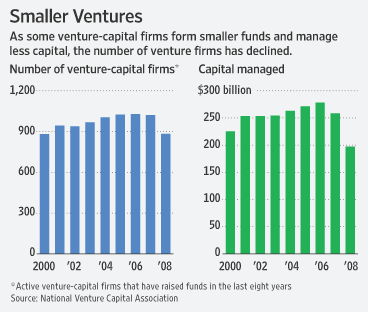
Future of VC What is the future for VC? David Aronoff, a parter at Flybridge Capital believes "The number of VC's must shrink."(FastCo) Fast Company notes "by some estimates the 1500 firms today will be just 500 within 5 to 7 years." (FastCo) So the future may be smaller rounds. Smaller rounds for more viable ideas that earn the principal back to the limited partners plus profit sounds gravy. I think the key to getting there is prototyping and iterating. Then number of VC firms is decreasing, but they won't disappear, they'll change.
I've been meaning to post a list of incubators that provide support via a blend of physical working space, server space and funding in New York City. It's coming up hot in the next post.
Sources: WSJ, Venture Capitalists Head for the Door, http://online.wsj.com/article/SB124416376153487535.html
Fast Company, Venture Capital - Under Siege? http://www.fastcompany.com/1627652/venture-capital-under-siege
Insightful but not quoted: eFinancial News, Venture capital firms slash staff numbers http://www.efinancialnews.com/story/2011-01-10/vc-firms-slash-staff