New York City - Global Service Jam

I just put up the New York City Service Jam site.

The premise is Stuff is getting more expensive, and that can be a good thing, given how unsustainable owning stuff tends to be.

Services are increasingly the way to go. But up till now managers have been in control of services, and we all experience the result – clunky, annoying, embarrassing, slow, or over-designed and inauthentically slick.

It’s time for designers to use their expertise at understanding how people like to live and work to make services that generate real value, that create new kinds of business, new kinds of government and new kinds of community.

Service Design faculty and from Parsons, with a little help from their professional practice friends, are going to be leading this weekend.

Take a look at http://bit.ly/nycservicejam

Join in by emailing Cameron Tonkinwise at tonkinwc@newschool.edu

Ideas to Action - frog design's methods + automobile casestudy

Topic: frog design: design process & research methodsSpeakers: Turi McKinley & Jason Severs [singlepic id=612] [singlepic id=606]

Inspiration from Jason's Past "just start anywhere" - quoting bruce mau "stop thinking, you don't actually know anything." Bruce Mau's Massive Change project www.massivechange.com

relation to is fine arts process to frogs collaboration design process but notes the difference of application. "In school, we called it commercial art"

[singlepic id=611 w=640 h=480 float=]"the world you take for granted is being aggressively designed for you."

Catalysts and Methods "Your way of being in the world, that's your way for …creative catalysts."

Situational Artefacts conversational stimuli -developing new software for stock traders -asking traders questions wasn't getting rich information, so they associated their time of day with artefacts [singlepic id=604 w=640] [singlepic id=603 w=640]

Serendipitous Collection never throw anything away

1/1 ratio we spend a year about thinking about things that you think about for one minute

Process Influence OODA Loop
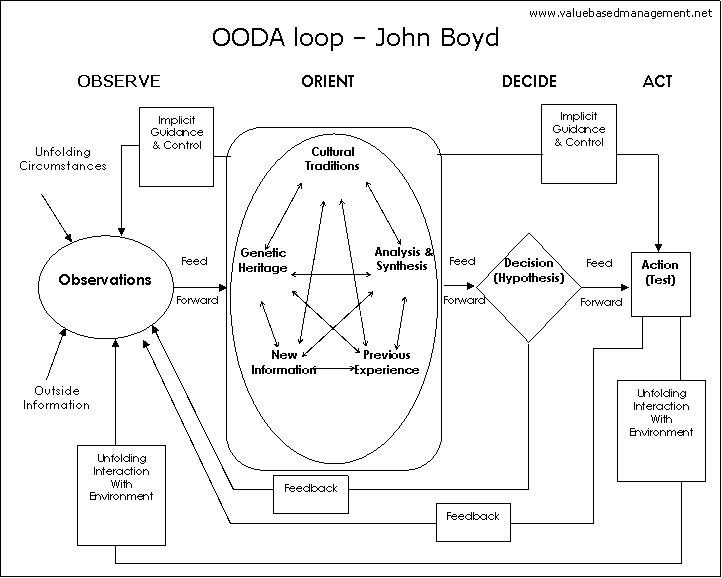
Memory draw the remotes from memory how do these old models fit with these new models

Design Process [singlepic id=608 w=640 h=480 float=] [singlepic id=605 w=640 h=480 float=]"It's this split, it's this moment of schizophrenia."* Analysis + Intuition - insight overlay (ven diagram)

CASE STUDY car in the future Goals: -Under stand the effects of the internet and conectivity in the car. -Design a user experience to help us bring drivers into the era of the connected car

Research Approach -contextual interviews -3 weeks, 5 locations, 46 people. -Japan, Italy, New York, San Francisco, London orchestrating how interviews go, over the minute if the client joins the field research, don't let them scare the interviewees

Research Tools rules of engagement - how should clients behave? notes - a framework with notes - featuring focal points an almost tangible UI -Building and ideating a real dash gave people cut outs and allowed them to build their own UI diary studies - keep your users' stories central to your work, show it to your clients

"Everything becomes amplified when you're out doing research, or at least it should. And, everything has meaning." -Jason

Trends Keys are [changing and] disappearing. You start to see mobile phones taking over that space.

Generate Insight analytical thinking and intuitive leaps

Design Principles drivers line of sight, single control display, visual voice, glance and touch, meidated access, detailed assitnacee, distirbuting labor, connections are  individual

Sometimes a design is too simplistic. Ex: "Too simplistic that a person forgot how to open their gass cap. Just press and it pops out, like a cabinet."  Similar to this lady locking herself in her car http://www.youtube.com/watch?v=SbX_I_lrmIc

User Proposals [singlepic id=609 w=320 h= float=]User proposal in the US [singlepic id=610 w=320 h= float=]User proposal in Japan - very slim design for a passive engagment Driving is already a "low-bandwidth activity," allowing the driver to be able to intermittently do other things while driving (Norman). There seems to be a trend for driving to become a lower-bandwidth activity for the user, with an increase in high-bandwidth for ambient information in the car. But Jason mentioned that they were reminded from user interviews that "Driving for pleasure" is still an important design parameter.

CLOSING Design is still thought of by some companies as the dark arts. so clients often don't question your findings from the filed altho you do work with your client's understanding of that.

The issue comes in when taking the idea to production because then you meet harsher constraints, financial, material etc

Coming in as the outside agency to the client's own specialty or design department ex: the automobile's radio designers. they may have 10 people that focus on one radio button. "that creates a friction."

It was good to see that a process is very detailed. Not only frog's design process process, but also the process they describe (in research), and the processes they invision as future experiences.

Thanks to Jason, Turi and frog design for the good presentation. *Note on that moment of schizophrenia - is supported by Teddy Cruz' comment “Designers are schizo by nature," when he spoke on Project Atlantis at Parsons. [nggallery id=50]

Source: Donald J Norman. Interaction Design for Automobile Interiors http://www.jnd.org/dn.mss/interaction_des.html


Bios and about via Parsons' original event info: Turi McKinley is a Principal Designer whose primary role at frog has been to create clear, compelling interactive experiences and strategic visions for frog clients, and to lead in the design research practice in the NY studio. Her broad experience spans design research, interaction design and strategy for clients such as Colgate-Palmolive, LG, Educational Testing Service (ETS), Humana, and Qualcomm. Prior to joining frog, she led design programs at MIT for clients including the University of Cambridge, the MIT Media Lab, and the MIT Entrepreneurship Center; developed social media software for emerging Eastern European markets; and worked on documentary films in Tibet, Nepal, India, rural China and Appalachia. She has degrees in Cultural Anthropology and Design.

Jason Severs is a Principal Designer who has helped to make frog an influential force in human-centered design. As a leader in the Design Research practice, he is responsible for promoting a systems-wide perspective on every project he engages, ensuring that the needs of users, businesses, manufacturers, suppliers, environment – and the rest of the value chain – are explored, understood, and considered as a part of the entire design process.

Before joining frog, Jason worked with Bruce Mau at the Institute without Boundaries on the project Massive Change and at Columbia University's Center for New Media Teaching and Learning developing courseware and distance learning applications.

frog design is a global innovation firm working with the world’s leading companies, helping them create and bring to market meaningful products, services, and experiences. frog's multidisciplinary process reveals valuable consumer and market insights and inspires lasting, humanizing solutions.

Date: Friday, February 25, 6p Location: Theresa Lang Center, 55 W. 13th Street, 2nd floor sponsored by D+M for Department Seminar 2: Design in Everyday Life

additional: themes emotional touchpoints personal connection to design -it doesn't really matter if you have personal connection to the things you are doing.

Automobile Interaction

I was impressed by my little brother kludging his mobile to his dashboard. We had the GSP nav running as well as Pandora.[singlepic id=596]

While cruising to DIA, all of a sudden the car asks, "Do you want to preform a systems check? To cancel, press 'OK'." In an androgynous version of HAL, the voice sort of freaked me out. My little brother said "No, I just took it in last week." My response was, "Why is the car talking? And why does the car have an "OK" button? This is not ok."

I thought Don Norman would be displeased.

[singlepic id=597] It turns out the "Ok" button is also the play, pause, and tune button as well as the volume toggle. It just happens to be one of the furthest buttons from the driver.

Pyramid (inverse pyramid of accuracy on top) "The automobile industry is copying all the worst features of the computer industry, ignoring all the advances in user-interface design" (Norman)

But as you try to create meaningful experience, the content is more more subjective, the ability to be effective is based off of different criteria. Kozatch PyramidThe auto industry is trying to design personal experiences, without first properly addressing usable, obstacle-free interactions. Ironically the interruption asking if we would like to perform a safety inspection could in fact be putting someone at risk of crashing. Norman notes "the real irritations of modern communication are those of human attention." So why is the car emulating a human voice and interrupting you while you drive at 85mph? Shouldn't there be a threshold - 45+ don't ask any questions. Or if there is snow on the road, don't ask any questions. Like mom had "let's play the quiet game," while trying to concentrate on driving. Or shouldn't there just be a feedback loop so the warning system registers that a systems check was already preformed?
There are many regulations when designing for automobiles, so the threat isn't so much that the notification was dangerous, the threat is that it the notification was pointless. In this case, the safety inspection was already completed. So the audio warning was dismissed. If the safety inspection was not completed, the audio warning would be dismissed, but there would be no note left behind reminding the driver of the necessary safety inspection.

Designing meaningful experiences requires an increased emphasis on research before production and as well as heavy user testing. [singlepic id=595 ]As the pyramid narrows at the top, it is easier to encounter a higher degree of dissatisfaction as a design is harder to match with peoples' expectations. There is a bigger question than how to refine the interface of a car. Why is there a new car model every year? That question popped into my mind a few years back. It's often a new shell with out much newer functionality. Pre-Cold War cars are kept well running in Cuba, and probably with a lot better milage than your 2006 model.

You can see it on the consumer level. Why are there so many marginally different models? It permeates onto its brand image level with the discontinuation of some brands. After the recession, auto companies saw they couldn't keep pushing superficially new models of every year in a redundant brand architecture.

On a systematic level, the nation's capital has a beltway that looks like a parking lot. New York has the best public transportation systems in the United States, but it is one of the worst in the world.*

The federally subsidized rail system from the nation's capital to the financial city is horrible. We have problems in the form of single buttons as well as the major veins of these systems.

Norman closes his piece on IxD for Autos with "Design specifications for the appropriate way to design, given the attentional demands and safety considerations for the driver. Ah yes, but this will have to wait. Work in progress."

We should get working.

*I'm not measuring how effective a transportation system is by the sheer number of people it moves. Donald Norman, Interaction Design for Automobile Interiors http://www.jnd.org/dn.mss/interaction_des.html

Service Design: More Than The Sum of Its Parts Recap

Today after flying in from Boulder, Dr. Andy Polaine gave an inspiring presentation on Service Design.He opened with the idea that all Service Design tools have been re-appropriated from other disciplines, but a Service Designer's end goals are different. He notes we are "moving from the joys of having things to the joys of having experiences." [singlepic id=588]

Dr. Polaine quotes Tibor Kalman with the question, "Do you want to die with the most toys, or do you want to die with the best life and experiences?"

Here's Matthew Hodgson's video about information architecture to show how different disciplines can use similar tools.

What are experiences and can we design them? "Cinematographers will tell you they can design experiences.At least they design the structures that we have expereinces through." "We can research experiences and context."

Not only can we research context, but we can design some of the context and we can change some of those things.

Service Design shouldn't just be broken into back stage and front stage, as like Don Norman says the back stage to one person is the front stage to the other.

Dr. Polain asks "What if we rethink that front stage back stage set up and instead have the users at the center, taking a role, interacting with eachother with some type of 'mediative interaction going on.'" He leads onto Virtuous Networks and how we are "shifting from products to services and to a people centered approach."

One concept that he places importance on is "arrows" or what I call "paths." The paths between the touchpoints. Sometimes you can flow through a service or ecology of services seamlessly and you may not even know it. A metaphor is like gaps in a sidewalk, you flow over it but don't notice it is there. (I guess that you can also flow over seams). That is the negative space of services. If there is a pothole or if the sidewalk is uneven, you will notice it is there. "When stuff breaks, that's when the arrows become visible." There is the phrase "you only notice bad design," which is why folded toilet paper is not the best example of Service Design.

Not only do you want to make some of the design unseen, but you may even want to tone down the design that is noticed. [singlepic id=591]

"It's easy to focus on the tangibles." "We tend to fetishize artifacts because it's easy, they're things we grasp on to." "There are plenty experiences where the artifacts seem to be right but the service ecology is [horrible]," like mobile phones. "Sometimes its worth downgrading a touch point so that" people can flow through it easier. The transition between touchpoints causes "a jolt in expectations." Like with many types of design, Service Design and the experience "it's about consistency, not just high level [execution] of anything." That is something I never thought of.

Dr. Polaine mentions Blueprint+, which I saw Roman Aebersold present on last year. My question about Blueprint+ and behavior research is how else can we plot emotion other than binary up or down, excited versus feared. An axis of solely excited or feared makes sense to a degree, but I would like to be able to plot multiple dimensions with additional values to cover a better picture of people's behavior over time. You can be excited and fearful at the same time.

The next steps for developing the Blueprint+ is to be able to "zoom in and out at different resolutions," providing very granular insight, but also being able to just show the major scenes. That will be amazing as a technical tool, it can work at different levels, to the second defining which small touchpoint is encountered, but also simplified to show the macro events when using it as a deliverable.

He's also writing a book withs Lavrans Løvlie and Ben Reason of live|work.

Check it out here: http://www.rosenfeldmedia.com/books/service-design/ Of all the Service Design books out or coming out, I expect this one to be really good.

[singlepic id=592] [singlepic id=593] [singlepic id=594] [singlepic id=589]The level we must reach. [singlepic id=590]Reminders to avoid the god complex.

Interaction 11 Photo Highlights

[singlepic id=544]Peter March[singlepic id=545] [singlepic id=546]Jackson Carson [singlepic id=548]John Yuda [singlepic id=550]Carl Aviani [singlepic id=551] Erik Hersman [singlepic id=552] [singlepic id=554] Eduardo Ortiz and Andrea Mignolo [singlepic id=556] Erik Dahl [singlepic id=557] Derek Chan [singlepic id=558] David Farkas [singlepic id=559] Alan Cooper [singlepic id= 560] Ruqian Zhou [singlepic id=564] [singlepic id=566] [singlepic id=568] Christopher Rider [singlepic id=569] [singlepic id=571] Freddy Ferrao [singlepic id=574] James Mulholland [singlepic id=576] [singlepic id=579] Sketch notes by Jason Mesut [singlepic id=580] [singlepic id=582] Brenda Laurel's presentation [singlepic id=585] [singlepic id=586] Jon Kolko

[nggallery id=46] I heard via Twitter that presentations should be up in about a week.

Service Design: More Than The Sum of Its Parts

DESIS Lab Presents
Service Design Performances – Spring 11 Series
SERVICE DESIGN: MORE THAN THE SUM OF ITS PARTS
With Andy Polaine
Date: Monday, February 14, 2011
Time: 6:00 to 7:30pm
Location: 80 5th Avenue, 8th Floor, Room 802, NY
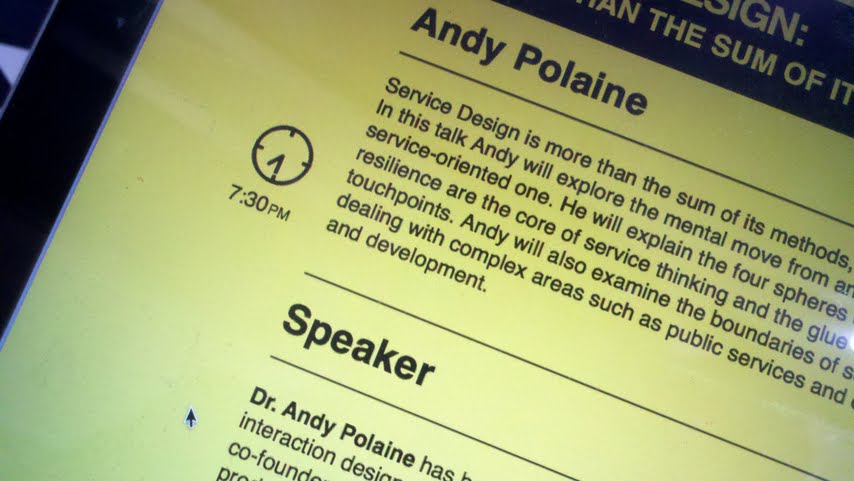
Service Design is more than the sum of its methods, blueprints and customer journey maps. In this talk Andy will explore the mental move from an industrial, product-fixated mindset to a service-oriented one. He will explain the four spheres of people, networks, experiences and resilience are the core of service thinking and the glue that holds together the more recognisable touchpoints. Andy will also examine the boundaries of service design and design thinking when dealing with complex areas such as public services and even international peace, security and development.
Dr. Andy Polaine has been involved in interaction design since the early 90s and was co-founder of Antirom in London. He was a producer at Razorfish, UK and later Interactive Director at Animal Logic, Sydney. He was Senior Lecturer and Head of the School of Media Arts at The University of New South Wales, Sydney before moving to Germany and is now a Lecturer and Research Fellow in Service Design at the Lucerne School of Art and Design in Switzerland. Alongside his academic work Andy continues to work as a interaction designer, service design researcher and is co-writing a book on service design for Rosenfeld Media along with live|work co-founders, Ben Reason and Lavrans Løvlie. [singlepic id=531]
---
Service Design Performances is an immersion experience in design for services, bringing together international professionals and scholars to present their work as well as presenting current and future areas of service design teaching and research at Parsons SDS.
Design for Sustainable Social Innovation and Sustainability (DESIS) Lab is a research lab at the School of Design Strategies, Parsons The New School for Design. Its mission is to advance the practice and discourse of design-enabled social innovation toward more sustainable cities. DESIS Lab conducts research into the ways in which design can enhance community led initiatives in the development of more sustainable ways of living and working. In particular, DESIS Lab uses Service Design as a means to apply design expertise into problem setting and problem solving related to sustainable practices and social innovation.

via School of Design Strategies at Parsons The New School for Design

See Andy Polaine's website here and twitter here.

Cities, Time, and Narratives. Amplified.

The panel focuses on three cities— Dubai, Las Vegas, Bangkok—to interrogate narratives that describe the relationships between cities and time. I could not make the talk as I am at Interaction 11, but here are some photos I took in Bangkok.

[singlepic id=526]Lumpinee Park - features a running track and public weight lifting station, pretty much an open air gym in addition to a nice place for a picnic. [singlepic id=527]Traffic at night. [singlepic id=528]Bed Supper Club. [singlepic id=529]Graffiti. [singlepic id=530]A soccer net mended with old shoes.

Panelists: Brian McGrath, Parsons The New School for Design Aseem Inam, Parsons The New School for Design Stephen J. Ramos, Harvard University Graduate School of Design

Moderator and Contact Person: Scott G. Pobiner , Parsons The New School for Design Scott's Bio

Time: Tuesday, February 8 · 6:30pm - 8:30pm

Location: Parsons The New School for Design / Theresa Lang Community and Student Center Arnhold Hall 55 W.13th St New York, NY

[nggallery id=44]

Large Animal Games

Keynote speaker Wade Tinney, CEO of Large Animal Games and an alumnus of the MFA Design and Technology program, discussed his own journey as game designer and entrepreneur.[singlepic id=524]

play testing, one week bursts,

Real World Lesson #1 (I'm missing lesson #1, if you know it, please comment!)

Real World Lesson #2 Learn from your failures [singlepic id=525] Real World Lesson #3 You're not part of your audience

Real World Lesson #4 Relationships are everything

Real World Lesson #5 Business is a series of design problems.

Event details: May 1, 2010. in the Anna-Maria and Stephen Kellen Auditorium. Parsons The New School for Design presents OneZero, the annual thesis symposium and exhibition of the MFA Design and Technology program. Taking place from April 29-May 2 in the Sheila C. Johnson Design Center at Parsons, OneZero is a series of talks, panel discussions, experiential installations, demonstrations, and screenings of research and work created by budding student artists, designers, programmers, developers, gamers, storytellers, and social entrepreneurs.

Event details source: http://www.artandeducation.net/announcements/view/1092

Ziba - Sunshine Generation - Design At The Edge

Sunshine GenerationBruce Nussbaum brought Ziba's Karen Reuther and founder Sohrab Vossoughi to Parsons on Monday the 7th. They open the presentation with "The revolution is underway." The presentation was based around the "Sunshine Generation" in China, young urbanites that grew up not knowing Tian'anmen's square and have only seen economy growth. [singlepic id=519] Karen Reuther of Ziba says "They call themselves sunshine because they are smiling" Some of what was presented can be related to the article "Oh, to Be a Millennial in China," by AdAge in 2010.

Ziba developed a few findings from their ethnographic research.

1 the youth are comited, their weapon is optimism

2 the shift is radical, and it is happening from the inside out they see china influenceing the world.

3. the scale is unprecedented w 340M 'revolutionaries' participating

One of their main insights was They are more similar than different (with us) Unbridled Optimism - "I don't just want to follow what others are doing. I want to do it myself" they like to "look different together." Anticipating Greatness - "My generation likes challenges. We want something unexpected."

I will post more on this later, including my views in relation to my experiences in China.

[singlepic id=515] [singlepic id=517] [singlepic id=520] [singlepic id=521] [singlepic id=522] [singlepic id=523] [singlepic id=518]

More about Ziba here: http://www.ziba.com/


This lecture is part of Bruce Nussbaum's Design At the Edge lecture series.

Cinemetrics Setup

[singlepic id=497][singlepic id=498] [singlepic id=499] [singlepic id=500] [singlepic id=501] [singlepic id=502] [singlepic id=503] [singlepic id=504] [singlepic id=505] [singlepic id=506] [singlepic id=507] [singlepic id=508] [singlepic id=509] [singlepic id=510] [singlepic id=511] [singlepic id=512] [nggallery id=42]