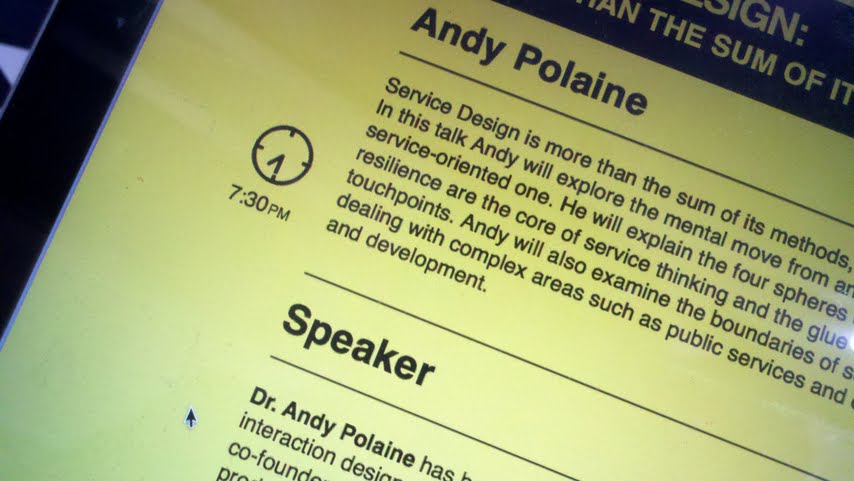
via School of Design Strategies at Parsons The New School for Design
See Andy Polaine's website here and twitter here.
via School of Design Strategies at Parsons The New School for Design
See Andy Polaine's website here and twitter here.
The panel focuses on three cities— Dubai, Las Vegas, Bangkok—to interrogate narratives that describe the relationships between cities and time. I could not make the talk as I am at Interaction 11, but here are some photos I took in Bangkok.
[singlepic id=526]Lumpinee Park - features a running track and public weight lifting station, pretty much an open air gym in addition to a nice place for a picnic. [singlepic id=527]Traffic at night. [singlepic id=528]Bed Supper Club. [singlepic id=529]Graffiti. [singlepic id=530]A soccer net mended with old shoes.
Panelists: Brian McGrath, Parsons The New School for Design Aseem Inam, Parsons The New School for Design Stephen J. Ramos, Harvard University Graduate School of Design
Moderator and Contact Person: Scott G. Pobiner , Parsons The New School for Design Scott's Bio
Time: Tuesday, February 8 · 6:30pm - 8:30pm
Location: Parsons The New School for Design / Theresa Lang Community and Student Center Arnhold Hall 55 W.13th St New York, NY
[nggallery id=44]
Keynote speaker Wade Tinney, CEO of Large Animal Games and an alumnus of the MFA Design and Technology program, discussed his own journey as game designer and entrepreneur.[singlepic id=524]
play testing, one week bursts,
Real World Lesson #1 (I'm missing lesson #1, if you know it, please comment!)
Real World Lesson #2 Learn from your failures [singlepic id=525] Real World Lesson #3 You're not part of your audience
Real World Lesson #4 Relationships are everything
Real World Lesson #5 Business is a series of design problems.
Event details: May 1, 2010. in the Anna-Maria and Stephen Kellen Auditorium. Parsons The New School for Design presents OneZero, the annual thesis symposium and exhibition of the MFA Design and Technology program. Taking place from April 29-May 2 in the Sheila C. Johnson Design Center at Parsons, OneZero is a series of talks, panel discussions, experiential installations, demonstrations, and screenings of research and work created by budding student artists, designers, programmers, developers, gamers, storytellers, and social entrepreneurs.
Event details source: http://www.artandeducation.net/announcements/view/1092
Sunshine GenerationBruce Nussbaum brought Ziba's Karen Reuther and founder Sohrab Vossoughi to Parsons on Monday the 7th. They open the presentation with "The revolution is underway." The presentation was based around the "Sunshine Generation" in China, young urbanites that grew up not knowing Tian'anmen's square and have only seen economy growth. [singlepic id=519] Karen Reuther of Ziba says "They call themselves sunshine because they are smiling" Some of what was presented can be related to the article "Oh, to Be a Millennial in China," by AdAge in 2010.
Ziba developed a few findings from their ethnographic research.
1 the youth are comited, their weapon is optimism
2 the shift is radical, and it is happening from the inside out they see china influenceing the world.
3. the scale is unprecedented w 340M 'revolutionaries' participating
One of their main insights was They are more similar than different (with us) Unbridled Optimism - "I don't just want to follow what others are doing. I want to do it myself" they like to "look different together." Anticipating Greatness - "My generation likes challenges. We want something unexpected."
I will post more on this later, including my views in relation to my experiences in China.
[singlepic id=515] [singlepic id=517] [singlepic id=520] [singlepic id=521] [singlepic id=522] [singlepic id=523] [singlepic id=518]
More about Ziba here: http://www.ziba.com/
[singlepic id=497][singlepic id=498] [singlepic id=499] [singlepic id=500] [singlepic id=501] [singlepic id=502] [singlepic id=503] [singlepic id=504] [singlepic id=505] [singlepic id=506] [singlepic id=507] [singlepic id=508] [singlepic id=509] [singlepic id=510] [singlepic id=511] [singlepic id=512] [nggallery id=42]
I'm sending this photo out as a stamp in my emails.新年快乐 ! Much better than stylized stationary emails. [singlepic id=496] The original work was by my cousin Clarence Lee in Hawai'i.
It's year of the rabbit! [singlepic id=492] [singlepic id=493]
Myy cousin Clarence Lee designed these stamps for the US Postal Service. See the full set of stamps for the Chinese zodiac here here: http://clarencelee.com/work-stamps-01.shtml
2011 is the second time I've seen the rabbit.
[singlepic id=494] [singlepic id=495] The newest rabbit stamps for 2011!
In New York, "The Empire State Building light up its tower red and gold to celebrate the Chinese Lunar New Year," via Xinhua.
Bill Moggridge of the Cooper-Hewitt spoke at Bruce Nussbaum's Parsons class Design-At-The-Edge.[singlepic id=487]
Thoughts on Research [singlepic id=483] ethnographic research latent needs you don't know what the designs are yet market research once you have the concept down and you have a prototype then you can focus on the explicit needs of market research
Intel's Social Networking Experience Prototype "a summary of touchpoints - interesting for a service design or any complicated system" [singlepic id=486] HOW - prototyping inspiration - evolution - validation "every prototype is a failure"
EXPANSION OF DESIGN "We find designers able to deal with more complicated contexts." designing stuff design of places - expands to social innovation rather than just structures designing for social impact - Human
WHO I. The Star Designer "It's a range from an individual effort to a team effort" Lisa Strausfeld - interaction design at Pentagram Frank Llyod Wright - Frank Gehry - who perhaps is the star of modern arch today
II. The Team Design thinking applying the same process but letting non-designers use it having an interdisciplinary team, you find that very difficult problems can be solved ex: a service designed for a visitor from China (Intel UMPC)
III. Crowd Sourcing proposed to be the third group of "Who" ex: esty, wikipedia Open IDEO makes it opaque who is contributing and to what degree, where as Wikipedia does not identify contributors that easily.
SYNTH'D NOTES: Increase your production values as you move up the prototyping stages.
ADDT'L QUOTES: "Venture capitalists tend to start from the business stand point. As designers we tend to start from the popele We have this starting point, it still needs to come to an overlap,...with the business viability"
"the values we have as human beings doesn't really change that much"
"In America we find that people are being forced into courses like math. "You of course being at Parsons have rebelled against that""
PEOPLE MENTIONED Ira Glass - American public radio personality radio goes through many prototyping iterations Shinichi Takemura - Tangible Earth he used to be an anthropologist currently at the Cooper Hewwitt [singlepic id=482] [nggallery id=38]
For more info:
http://www.designing-media.com/download
"Concepts that become evident in film become applied in our own practicesHow we experience the world and then take that into our [design or professional] practice." Brian McGrath
[singlepic id=489]
matter-flux/open whole "bergson's conclusion...:if the whole is not giveable...it is because it is the Open, and because its nature is to change constantly, or to give rise to something new, in short to endure." "The duration of the universe must therefore be one with the latitude of creation which can find place in it." (Deleuze, Cinema 1,p9) "The real whole might well be...an invisible continuity"." (Deleuze, Cinema i p1_). "Act on it one piece at a time." BM set of information - "a way of looking at an image, not as a picture, but as a set of elements in relation to each other which give you a limited frame of the open whole."
immobile cuts or section: a closed unmoving system/set.
frame - We will call the determination of a ...relatively closed system which includes everything which is present in the image - sets, characters and props - framing." (Deleuze, Cinema_ - "you can't close the whole world out, you can only close out certain information in a frame." BM
movement image - "Movement as physical reality in the external world, and the image, as a psychic reality in consciousness, can no longer be opposed." Deleuze defines the movement image as "the centered set of variable elements which act and react on each other." ( perception image - "set...of elements which act on a center, and which ( objective perception ex: your percept of the room if you are viewing it from the door outside subjective perception - means you're inside the "scene" ex: your percept of the room if you are siting inside it affection image - -we become intimate with these characters, we empathize and identify with them. -less about worldly information and more about the qualities of the individual, the qualities of the face. a close up. thought image has to do with memory reflection image - remembering and reflecting what has happened and overlaying it to what is currently available. (recalling information) -relating the present to the past -by the time it reaches the brain, it is already in the past relation image impulse image- "the energy wich seizes fragments in the originary world." (Deleuze, Cinema 1, pg 124.)" "between affection and action is impulse" action image - "reaction of the center to the set." (Deleuze, Cinema I, p.217) "The action image frames the body in a medium distance shot." sensori motor system - "Bergon states in Creative Evolution that 'the sesnori-motor system' [is] the cerebro-spinal nervous system together with the sensorial apparatus in which it is prolonged and the locomotor muscles it controls," (p. 124). sensori-motor schema - "organizes and coordinates the perceptions, affections, and actions of each living image, and from this schema issues particular configuration of the world..." (Bogue Deleuze on Cinema, p4.) "extensions to our sesnori-motor apparati - ex: digital tools, body practices like yoga or boxing." BM "a schema to help us understand ourselves both as hunters and cyborgs" BM first the hunter develops the skills, the locomoot muslces skills, and then devleops a hunter schema eventually to develop a schema betwn ceberbor spinal nervous sytem _ locomortor muscles. "this is how we can be change detectors and change agents." BM
living image/interva/center of indeterminacy - is the center odf indetermination of a living image, an interval or gap in the universal interaction of matter flows"How do you construct an interior space, a reality from scenes in the film? objective perception/subjective perception - movmeeng images are either objective or subjective. Objective per is provisionally defined as a point of view from outside the framed set, while subjective perception isd efined as a point of view from within the freamed set. (Deleuze, Cinema 1, pg 71-6) nbsp ex: "you assume you're looking at the wife through the view of the husband's eyes and the husband from the view of the wife's eyes. if the camera assumes that position, it is subjective" BM
"There's something powerful about that camera that just sits there, is meditative and watches the world go by."BM
While he uses static shots, the camera changes places between shots, so in that sense it moves. He is always at right angles to the room he is filming like an architect.
add'l shots - static moving temporal
Change blindness - "sometimes my mind creaties patterns of history, am i seeing reality or am i seeing something i remember." BM
re: using two different ladies in Ozu's film
Films Mentioned:
Gaspar Noe's "Enter the Void" 2010
Sources: Deleuze, Cinema I BM - Brian McGrath
My Questions: How do you do that when there are shots that aren't just static - like panning and tilting or using a dolly. Why do you want to get the metrics and measurements of the building? Especially when it could be a a set - so it is a partial and fake reality that you then try to define.
[nggallery id=39]
DREAM:IN ConclaveTo read the common dreams of India and develop big ideas for business, policy, development and sustainable change, and work towards realizing them, leaders and design experts from India, USA, Brazil and Italy will be joining us at the conclave from 16th to 19th February 2011. The DREAM:IN Conclave will bring together 55 national and international leaders to share a vision for India through design. During 4 days in Bangalore, the knowledge center of India, thousands of Indians’ dreams will be interpreted by entrepreneurs, business leaders, design and creative thinkers, venture capitalists, policy makers, and financiers to design transformative changes for India. Dream Volunteers consisted of students in design, anthropology, marketing, finance, technology, urbanism will synthesize and broadcast through the DREAM:IN Portal the visionary scenarios and opportunities for investing in India’s prosperity. The DREAM:IN Conclave works towards bringing global design expertise to fulfill common dreams of locals. With an open source database of dreams, visions, and investment opportunities India will be ready to change the lives of people locally and globally.

Connect with DREAM:IN Twitter: http://twitter.com/#!/DREAMIN_Team
Facebook: http://www.facebook.com/dreaminteam
Vimeo: http://vimeo.com/dreamin
Flickr: http://www.flickr.com/photos/dreaminteam/
See below for more details on specific phases
DREAM:IN Collecting India's aspirations as a canvas for creative thinking Challenging the notion that future thinking should be informed by people's needs – the DREAM:IN initiative seeks to explore what Indians are dreaming about. It intends to create a dynamic database of dreams gathered in cities, towns and villages across the country. These will be categorised, analysed and shared with business leaders, educators, social entrepreneurs, policymakers and designers to devise transformative and inclusive future scenarios. DREAM:IN intends to collide the dreams of a diverse India with the thoughts and actions of leaders across a range of sectors.
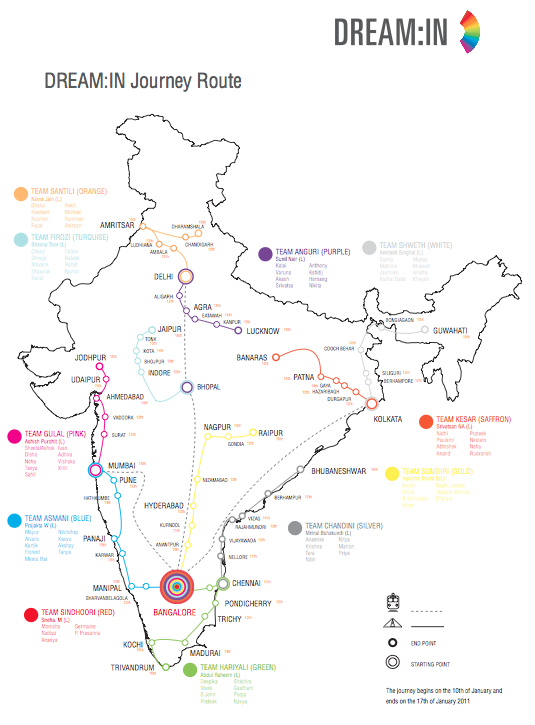
DREAM:IN Journey 8-17 January 2011 101 dreamcatchers have been selected from students from over 20 Indian institutes of management, design, communication and film. They will be dispatched in groups across 11 itineraries which traverse rural and urban India. Along the way they will be questioning locals about their dreams and aspirations – for family, work, recreation, products and services – and capturing these on video. They are expecting to collect over 10, 000 dreams. Before heading off they will receive training from a team from various backgrounds including ethnography, education, advertising and cinematography from across India plus Brazil, Italy, New Zealand and the US. This group features professionals from Nokia, Ogilvy & Mather and Parsons the New School for Design (New York). The findings will be returned to the DREAM:IN headquarters in Bangalore to be collated and categorised ahead of the conclave.
DREAM:IN Conclave 16-19 February 2011 February's summit will bring together a selection of students, educators, policymakers, social entrepreneurs and professionals from sectors such as finance, IT, retail, telecommunications and energy. Participants include powerhouse retail entrepreneur, Kishore Biyani and Fast Company's Bruce Nussbaum. Findings from the dream journey will be shared through a series of workshops. These will be used to inform future scenarios via a rigorous design-thinking methodology – with the view to devising concrete projects to effect fresh thinking around delivering products and services at scale.
DREAM:IN Portal Feb 2011 onwards An open portal will be launched which allows users to upload and categorise dreams by sector – adding to those collected on the dream journey. These will be supplemented by scenario building tools to assist professionals to translate the dream database into insights which can inform their future strategies. Drawing on the larger canvas of dreams over needs is expected to fuel enhanced creative thinking.
The DREAM:IN project has been driven by Idiom Design and Consulting in Bangalore and their design education initiative SPREAD. Inception and direction: Sonia Manchanda, Idiom. Enterprising design knowledge and global markets specialist: Carlos Teixeira, Parsons the New School for Design. Supported by IBM, Manipal University and Mr Kishore Biyani.
Source: Updates on the DREAM:IN Journey_Bangalore, India email from Carlos Teixeira.