NYC UX Community Holiday Party

Yesterday was the UX Community's annual holiday party, attended by IxDA, UPA to name a few. I attended with my friend Jake from Parsons' Design+Management program.  It was mostly relaxing and socializing. But I learn about new things every time I meet with members of these groups. We met a number people there who majored in English, liberal arts, or journalism. That is because just a few years ago degrees were not available for the disciplines they now practice. Which is interesting for Jake and myself because he is getting a BBA in Design+ Management and I am getting a BFA in Integrated Design. Those are not common job titles. It isn't necessarily our goal to make them more common titles. We're looking define new roles, new methods and from that may come new titles. [singlepic id=255] [singlepic id=257]

Topics we brought up: Service Design for transportation - specifically airlines Redesigned airline tickets - passfail.squarespace.com brought to my attention by Jess Eddy who has great work.

Information Architecture - Do you have any examples of good IA for a site including search functions that aggregate info from other organizations? Specifically for services like OpenTable or Kayak - where there is info from many restaurants and hotels.

960 Grid System - Fluid 960 Grid System - featuring code download 960 Grid System - featuring Illustrator, InDesign, Flash template downloads etc

Architecture - Bjarke Ingels 3 warp-speed architecture tales on TED Bjarke Ingels Group website

Joshua Prince-Ramus uses Hyperreality Designing the Seattle Central Library TED on youtube

[nggallery id=16]

LeftLoft, Italian Design Studio Opens in New York

Leftloft, an Italian design studio opens it doors in New York this year.  They had a reception for their studio launch earlier this week on Fifth Ave, right around the corner from Parsons.  They describe themselves as an "independnt graphic design company based out of Milan, Italy." They do graphic design and creative direction/strategy.  They've aslo done some really nice information design and design for environments.Some of their clients include: Moleskine, Pirelli, Politecnico di Milano, Car Sharing Italia [singlepic id=232] [singlepic id=246] CMGN [singlepic id=238] Paul from Pentagram New York [singlepic id=233] 倍耐力Perelli 是一家CSR公司 [singlepic id=239] Touchpoint Genius!  It's like the Ridel logo that has been etched inversely on the bottom of their crystal, so when you finish a glass you are looking right at their logo. [singlepic id=249]

Check them out at http://leftloft.com/

[nggallery id=15]

Luxury Design Strategies LEF Final Presentations

LUXURY DESIGN + STRATEGYFor the past 16 years Parsons students have collaborated with MBA students from Columbia University to develop brand-strengthening design solutions for luxury companies.

This year, teams were chosen to research and design for Hermès, Bulgari, Maclaren, Loro Piana, Haviland. Each company had a unique case, requirements and goals. It is good to see more professionals and people from different backgrounds change their view of design from something of decoration to a force of actual function and meaning. Increasingly I notice more business schools getting involved in design. Like Carnegie Mellon, Harvard, Stanford and Columbia.

[singlepic id=202] SITE Students meet at Parsons, Columbia University, and the offices of the companies’ chief executives for discussion and working sessions. [singlepic id=200] BOARD OF DIRECTORS: Barbra Cirkva, Chair Ketty Maisonrouge, President
ADVISORY BOARD: Assouline: Prosper Assouline, President & Founder Bulgari: Veronica Trenk, Managing Director Cartier: Emmanuel Perrin, President & CEO Chanel: Barbra Cirkva, Division President, Fashion, Watches and Fine Jewelry Christian Dior: Pamela Baxter, President & CEO Graff: Henri Barguirdjian, President & CEO Gucci: Laura Lendrum, President & CEO Hermès: Rober Chavez, President & CEO Lalique, Haviland, Daum: Maz Zouhairi, President & CEO Loro Piana: Fabio Leoncini, Managing Director, Luxury Goods Louis Vuitton: Geoffroy van Raemdonk, Acting President Luxottica: Andrea Dorgio, EVP of Wholesale North America LVHM Perfumes and Cosmetics: Pamela Baxter, President and CEO Maclaren: Farzad Rastegar, President

Special Thanks to Heico Wesselius and Andrew Cornell Robinson of the Design+ Management department of Parsons The New School for Design

[nggallery id=13]

links + sources:
http://www.newschool.edu/parsons/luxury-education-foundation/
http://www.luxuryeducationfoundation.org/ [singlepic id=194] [singlepic id=195]

Inflated view of China's Growth

20101206-chinas-export-machine-caps.jpg

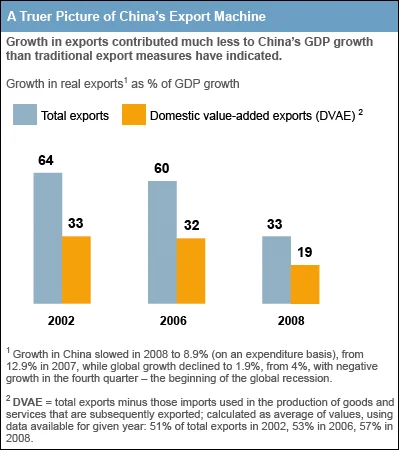
China's exports are less dominant than we initially perceived.  That is because "many of China's export shipments include imported goods that are reassembled" before being finally exported.  That creates an inflated view of the number of exports that China actually has and skews our view of China's growth.Researchers developed a new metric called "domestic value added exports" which are total exports minus all imports used to produce goods that are subsequently exported.

Domestic Value Added Exports Equation DVAE = [total exports] - [imports used to produce goods that are subsequently exported].

DVAE

In 2008, China's total exports were 33% of their GDP.  DVAE was 19% of their GDP, meaning that only 14% of their GDP was from pure exports which entirely originated from China.

This is more reason to use the term GNI (Gross National Income) instead of Gross National Product, because much of what is produced is not an actual product but a service or combination of internationally sourced products.

This article supports my view that the world is: 1. over emphasizing China's growth and power 2. too reliant on physical products -we are not measuring the output of these products (impact on people's lives or the environment) but we also are not properly measuring the input into these products. 3. needs new methods of identifying ways to measure production and income (on both a level for nations and individuals).

quotes via HBR HBR article - http://web.hbr.org/email/archive/dailystat.php?date=120610 Original study A truer picture of China's export machine by McKinsey Quarterly -http://www.mckinseyquarterly.com/Strategy/Globalization/A_truer_picture_of_Chinas_export_machine_2676?gp=1

AIGA Design Educators Conference - Remapping the Curriculum

Part I: Remapping the CurriculumOne of Six Views of the AIGA Design Educators Conference Quotes by Jon Kolko

Shelley spoke on "Described the changing qualities of culture and society and the new demands placed on design educators in driving specialization toward fields like service and interaction design."

Christopher Vice - spoke on how "We must actively and aggressively reframe design education in order to best meet the challenges facing our world and culture."

"For most of the field’s history, educational programs in graphic design have taught students how to create artifacts. That involves a number of core competencies, including but certainly not limited to color theory, two-dimensional design, three-dimensional design, typography, composition, printing and prepress, packaging, digital prepress, logo and mark creation. But the world has changed, and professionals rarely focus exclusively on printed material. In the last 20 years, the overall landscape of design has shifted: — From single artifact-systems to design language systems, focusing on a unified visual and semantic message across multiple printed pieces — From one-way communicative artifacts, such as brochures, to interactive artifacts, such as software — From designed artifacts to “design-thinking,” where the focus of the design process is applied in the context of large-scale business, organizational or cultural problems — From commercial goods toward service, emphasizing time-based, human and more experiential qualities of designed offerings

Suggestions: 1. Recast the Foundation (good, because I only took one foundation class.)

2. Specialize and Differentiate I think we should also integrate the skills that are specialized and different. You need verticals ex: human factors engineering, typography. "— Focus on service design or interaction design. " "— Focus on partcipatory design" "— Focus on traditional design specialites"

We're not designing artefacts - maybe we're not even designing ways of thinking (as that may simply be impossible). We are designing methods of thinking, we design the pathway and the specific prompts within them.

Changing Design Education "increasingly questions consumption and advertising, which are at the heart of industrial and graphic design disciplines." "There is an increased demand for service-based jobs as our country re-evaluates economic sustainability. People are demanding quality, reflective and meaningful experiences in their world."

"The subject of design is the humanization of technology, and as long as technological advancements continue, so the pragmatic and day-to-day jobs of designers will continue to morph. And so must design education continue to evolve."

------------- Questions I pose, to myself and maybe prompts for others to think about: What is your vertical (deep area of specialization)? It may be something that can spread across a wide domain, or be applied to other domains.

How to make the game more meaningful and effective. How to make it more fun? We'll get to that after we address the basics. We must "dramatically revamp their courses or face irrelevance."  That is I am a test tube baby, a prototype generation for design education.

Cameron Tonkinwise asks, "If designers are innovative creatives why are they so very tame & lame when it comes to redesigning design education" (via Tiwtter @camerontw) Possibly because professors are scared of becoming irrelevant and design students are afraid of studying a discipline that does not exist yet.  Although, that would be parcipatory design for design education - crafting the discipline as you define it.  Additionally that would be creating the cirriculum as it is taught.  Some of the main barriers to redesigning design education may be based in the fear of it becoming an act of blacksmithing design education. Full text: http://observatory.designobserver.com/entry.html?entry=22988 Update Jon Kolko is now heading up the Austin Center for Design, which has a focus on social design and real world impact. They aim to create impact by "emphasizing creative problem solving related to human behavior, through the use of advanced technology and novel approaches to business strategy." Learn more about ACD here: http://www.austincenterfordesign.com/

Jon Kolko from Ix11

Designing Meaningful Experiences

David Kozatch, founder of D.I.G spoke, at IxDA about Designing Meaningful Experiences. [singlepic id=146 w=width h=height mode=web20|watermark float=left|right]

Topics: How we can make experiences emotional. Information overload, how we can make information useful. Adaptive UIs Helpful - non-intrusive -Interested -Simple and Clear -Respectful -Forgiving Related: 3 Levels of Experience Don Norman Talk on Design of the Future Things Front Stage Back Stage - Service Design Don Norman's Ted Talk on  Design and Emotion Denis Dutton's Ted Talk on Beauty on A Darwinian theory of beauty

Svcs/Software Mentioned or Used: Jing, Blekko - new search engine,

See IxDA for a universe of information. Follow IxDA NYC on Eventbrite to get notified about future events. The next one is a Winter Social/Holiday Party details TBA.

official event info: ABOUT OUR SPEAKER David Kozatch founded D.I.G. in 1989, after almost ten years serving in the trenches at major packaged goods companies and advertising agencies in New York. David has conducted literally thousands of focus groups and in-depth interviews in the areas of financial services, software, hardware, Web/interactive services and telecommunications. With a deep understanding of business decision makers and end users, he has consistently worked to translate client objectives into actionable solutions. For more information about D.I.G, please visit Digsmarter.com.

[nggallery id=10] slides from David's slidsahre: http://www.slideshare.net/dkozatch/designing-for-meaningfulexperiencesixda-slideshare

ABOUT OUR HOST J.P. Morgan is a leader in financial services, offering solutions to clients in more than 100 countries with one of the most comprehensive global product platforms available. We have been helping our clients to do business and manage their wealth for more than 200 years. Our business has been built upon our core principle of putting our clients' interests first. To learn more about JP Morgan, visit the website.

Participants + Attendees - Service Design Conference 2010 – Cambridge